

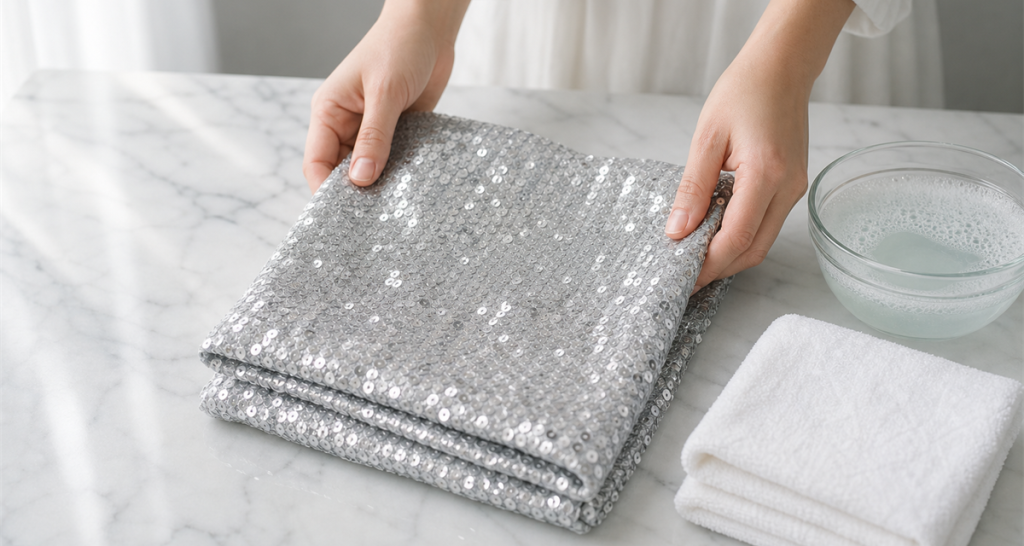
Sequin fabric wash care starts with one rule: never let sequin panels tumble freely against each other. For B2B buyers the practical answer is a cold, low-agitation wash programme, a mesh laundry net, no chlorine bleach, and low-heat flat drying — then a lab-confirmed sample that both you and the factory keep on file. Place bulk orders only after that reference sample is signed. This guide sets out the sequin fabric wash care standards, care-label fields, and approval checkpoints that protect colour, shine, and hand feel from first swatch to final shipment.
What Is Sequin Fabric Wash Care?
Sequin fabric wash care is the tested set of instructions — water temperature, agitation level, detergent chemistry, drying method, and pressing rules — that keeps sewn or bonded sequins attached and reflective after repeated cleaning. It is not one universal setting; it is a specification you agree with your supplier and then print on the care label.
Because a sequin is a hard, sharp-edged disc stitched or glued onto a base fabric, the main risk is mechanical rather than chemical. Abrasion snaps stitch threads, heat warps PET film, and chlorine dulls metallic coatings. A reliable sequin fabric wash care standard therefore controls agitation and temperature first, chemistry second, and always defines a signed reference sample. Buyers who skip this step inherit complaints, chargebacks, and unsellable stock.
Key Takeaways
- Cold water (maximum 30 °C / 86 °F) with low agitation protects sequin stitching better than any detergent choice.
- Always wash inside a mesh net, individually or in very small loads, to stop sequin-on-sequin abrasion.
- Never use chlorine bleach, fabric softener, or hot tumble drying on sequinned goods.
- Dry flat or line dry in the shade; heat is the fastest route to warped and clouded sequins.
- Lock the care specification on a signed sample before bulk and repeat it on the packaging note.
- Our minimum order quantity for approved decorative fabric is 200 yards, so get care right the first time.
How to Wash Sequin Fabric: Step-by-Step
Use this sequence for lab samples, test panels, and finished garments. It also doubles as the instruction sheet you can hand to your own customers.
- Confirm the construction first. Check whether sequins are sewn (stitched) or bonded (glued). Bonded sequins tolerate less heat and shorter cycles than stitched sequins.
- Test a hidden panel. Wash a 30 cm swatch and compare it with your signed reference sample under neutral lighting before you touch the full roll or garment.
- Turn the item inside out. Close all zips, hooks, and snaps so metal components cannot catch sequin edges.
- Place it in a mesh laundry net. One garment per net; never mix sequins with towels, denim, or anything carrying hooks or hook-and-loop tape.
- Select a cold, gentle cycle. Use a maximum of 30 °C, a short programme, and a low spin speed of 400–600 rpm.
- Use a mild liquid detergent. A neutral, bleach-free, softener-free detergent protects coatings and thread lubricants.
- Rinse and remove immediately. Do not soak sequinned goods; prolonged wet contact loosens adhesive and dulls metallic finishes.
- Dry flat in the shade. Lay the item flat on a towel, reshape it, and air-dry away from direct sun and radiators.
- Store with care. Hang or roll with acid-free tissue between panels, and keep items away from damp walls and heavy stacked weight.
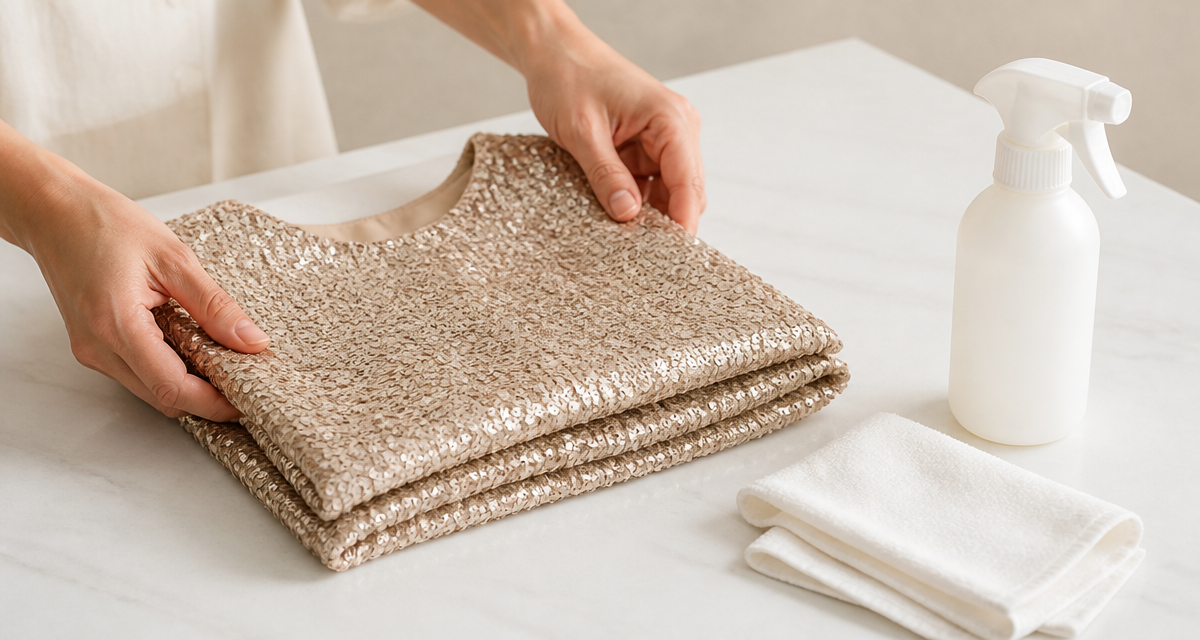
Care Specification Fields to Lock Before Bulk
Copy these fields into your purchase order so the factory, your QA team, and your customer-facing label all describe the same routine.
| Field | Recommended setting | Why it matters |
|---|---|---|
| Wash temperature | 30 °C / 86 °F maximum | Prevents PET sequin warping and adhesive softening |
| Agitation | Gentle, short cycle, 400–600 rpm spin | Reduces mechanical abrasion on stitch lines |
| Detergent | Neutral liquid, no bleach, no softener | Protects metallic coatings and thread lubricant |
| Protection | Mesh laundry net, inside out | Stops sequin-to-sequin and sequin-to-hardware snagging |
| Drying | Flat, shade, low heat | Avoids distortion and surface clouding |
| Reference sample | Signed swatch kept by buyer and factory | Gives both sides one objective quality benchmark |
Sequin Fabric Care Methods Compared
| Method | Water temperature | Agitation | Best for | Main risk |
|---|---|---|---|---|
| Hand wash in a basin | Cold, 20–30 °C | None | Heavily beaded or bonded panels | Slow, and hard to standardise in a factory SOP |
| Machine, gentle cycle in a net | Cold, 30 °C | Low | Stitched sequin garments in production | Higher abrasion if the load is too full |
| Spot clean only | Room temperature | None | Delicate trims, structured shoulders | Does not remove embedded body oils |
| Professional dry clean | Solvent based | Low | Premium eveningwear, lined styles | Solvent can attack some adhesives; always test first |
Common Sequin Fabric Wash Care Problems
Sequins curling or clouding after washing
Heat and hot tumble drying are the usual causes. Re-set the wash temperature to 30 °C and switch to flat shade drying. If the issue repeats, review sequin fabric heat sensitivity with your supplier before the next run.
Thread breaks along the stitch line
Overloaded drums and missing mesh nets are the main culprits. Reduce load size, keep one item per net, and confirm needle and thread specifications using our sequin fabric needle compatibility guide.
Colour shift or dulling
Chlorine bleach and prolonged soaking strip metallic coatings. Test colour stability early with our guide to sequin fabric colorfastness, and confirm shrinkage behaviour using the decorative fabric shrinkage testing protocol.
Folding marks that will not relax
Storage pressure, not washing, causes most permanent creases. Read our notes on decorative fabric fold mark recovery and specify roll or hanging delivery.
Who Needs a Documented Sequinned Wash Standard?
Anyone who sells sequinned goods to a third party needs this document: fashion brands, bridal and eveningwear labels, event decorators hiring out tablecloths and backdrops, dance and stage costume suppliers, and retailers who resell finished products. The moment a customer launders a garment, your brand owns the result. A written standard shifts the conversation from opinion to specification, tells the factory exactly what performance to deliver, and gives your customer service team one accurate answer instead of three.
How Wash Care Affects Sampling and Bulk Cost
Care performance is decided long before washing. Sequin type, base fabric, stitch or adhesive quality, and thread specification all determine whether a garment survives ten cleaning cycles. If you test care at sample stage, changes are cheap, because you adjust the sequin grade or the base before any bulk run. If you test after 200 yards are delivered, the fastest remedy is usually a downgrade you did not plan for. Build one wash trial into every sample round and record the result on the spec sheet.
Frequently Asked Questions
Can you machine wash sequin fabric?
Yes, if the sequins are securely stitched and you use a cold, gentle cycle inside a mesh net. Bonded or glued sequins should be hand washed or spot cleaned instead.
What temperature is safe for sequin fabric wash care?
Stay at or below 30 °C / 86 °F. Anything hotter risks warping the sequin film and softening the adhesive on bonded styles.
Can I use fabric softener or bleach?
No. Softener leaves a film that kills reflectivity, and chlorine bleach attacks metallic coatings and can yellow the base fabric.
How should bulk sequin fabric rolls be stored?
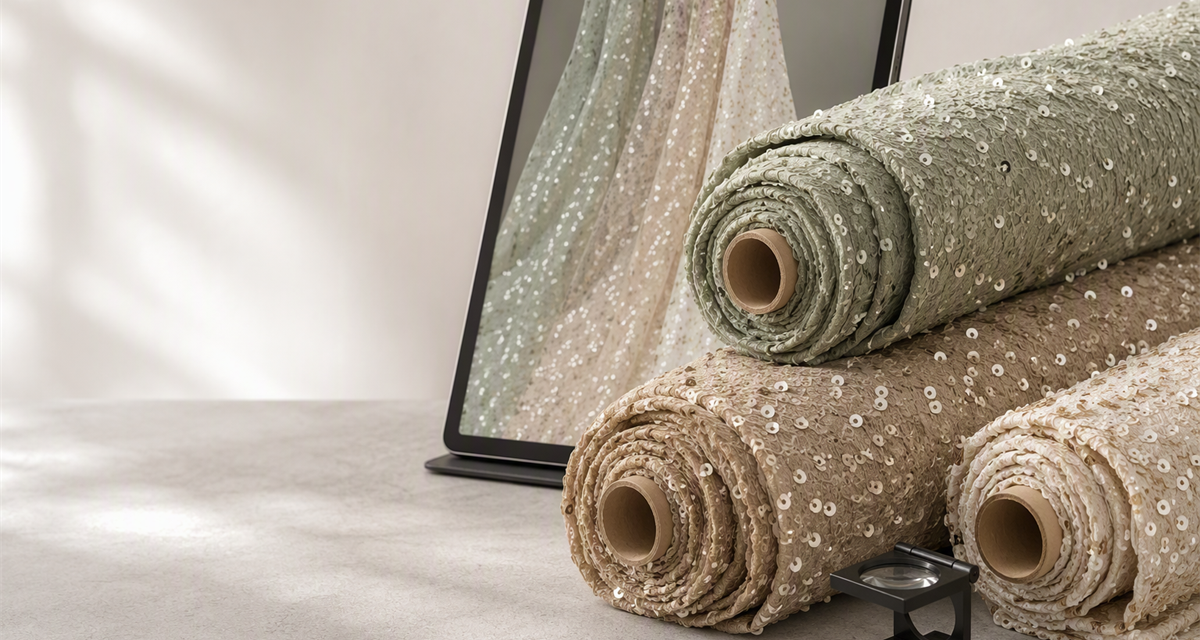
Store rolls vertically or horizontally in a dry, shaded area at moderate humidity. Keep them off damp floors and never stack heavy weight on decorated faces; see our decorative fabric packaging standards for roll and carton details.
How do I approve a care standard before ordering 200 yards?
Test a swatch, record the exact programme, compare against your reference sample, and sign both copies. Our team can supply a care-tested swatch with every sample set.
Set Your Wash Care Standard Before You Order
Good sequin fabric wash care is a purchasing decision, not an afterthought. Write the temperature, agitation, detergent, and drying rules into your specification, prove them on a sample, and hold that reference on file. That single discipline prevents the most expensive defect in decorative textiles: a beautiful fabric that cannot survive its first clean.
Request Sequin Fabric Samples and a care-tested reference swatch to validate your programme before bulk. Our team will match base fabric, sequin type, and care performance to your collection.
Source direct on Alibaba - request bulk pricing, specifications, and production details in one place.
View Yunfan Textile on AlibabaContact: Morris — morris@yunfantextile.com — WhatsApp: +86 156 3752 5803 / +86 175 1619 6727






