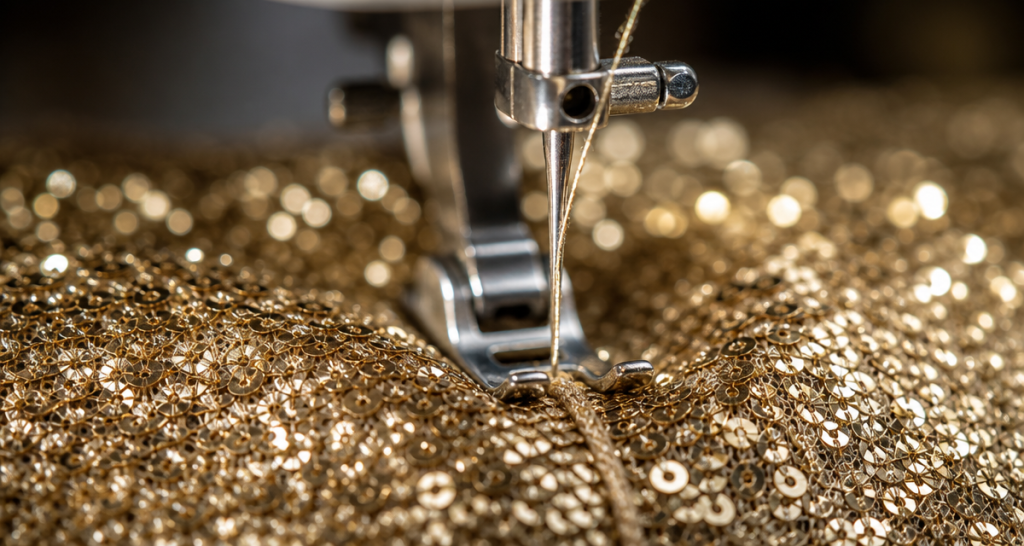
Sequin fabric needle deflection is the sideways bend of a needle when it strikes a hard sequin edge or a stacked overlap. Buyers can control it by matching needle type and size to the sequin, slowing the machine at dense areas, and supporting the seam so the needle stays straight. This guide explains why deflection happens, how it turns into breakage, and which specification fields to approve before bulk sewing starts.
Key Takeaways
- Needle deflection begins where two sequin discs overlap.
- A ball-point needle pushes sequins aside, while a sharp point can cut them.
- High machine speed raises deflection and breakage on dense panels.
- A supported seam keeps the needle straight and the stitch clean.
- Record needle type, size, coating, and replacement interval in the spec sheet.
- Re-test after every new sequin delivery, because disc hardness drifts.
What Is Sequin Fabric Needle Deflection?
Sequin fabric needle deflection is the lateral bending of a needle as it passes through a decorated surface. The needle wants to travel straight, but a hard sequin edge pushes it to one side. As a result, the needle flexes, the stitch shifts, and the tip may brush the needle plate.
Deflection is not the same as wear. Wear is a slow change in the needle point over thousands of stitches. In contrast, deflection is a force event, and it can break a needle in a single stroke. Therefore, the fix is mechanical rather than cosmetic.
Why Needle Deflection and Breakage Raise Bulk Costs
Deflection damages more than the needle. When the needle bends, the stitch moves, so the seam line wanders. Moreover, a deflected tip often chips the sequin film and leaves a dull pit on the panel. Both faults are hard to see at the machine, yet they show up under raking light at final inspection.
Breakage adds a second cost. A snapped needle can mark the fabric, and the operator stops the line to clear the machine. In addition, a broken tip may fall into the panel and reach the customer. Consequently, one weak needle setting can create rework, delays, and claims at the same time.
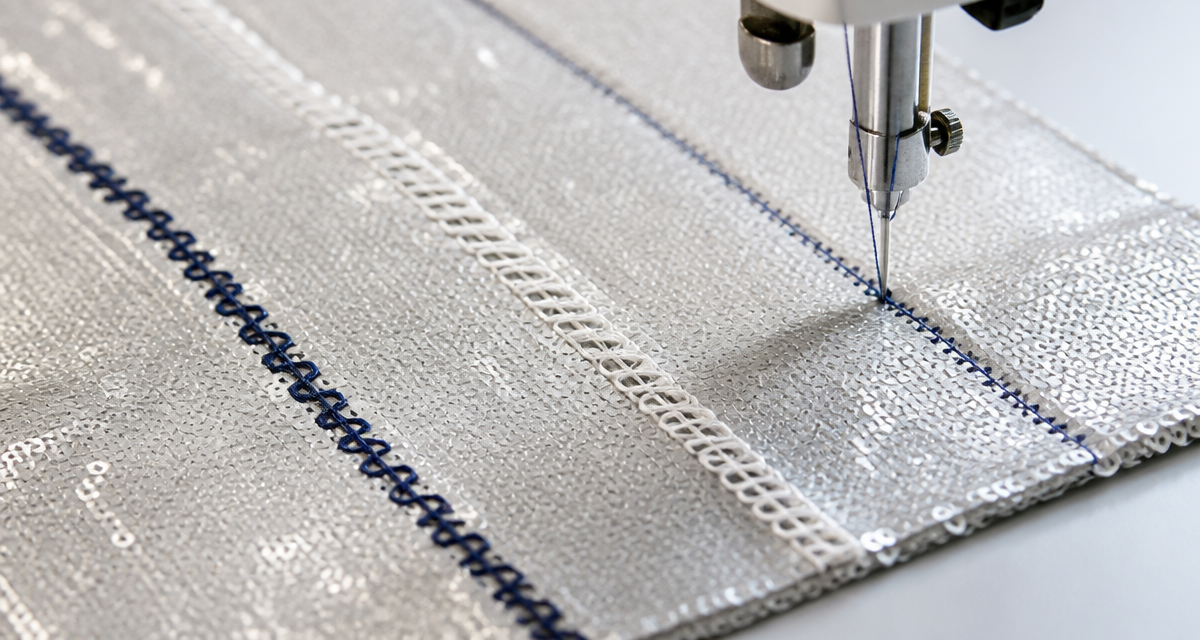
How to Reduce Needle Deflection: Step-by-Step
Use a fixed sequence, and document each result. The steps below work for woven, mesh, and chiffon bases.
- Identify the sequin size, film thickness, and base cloth before you choose a needle.
- Select a ball-point needle for sequin work, because it slides between discs instead of cutting them.
- Match needle size to fabric weight, and avoid the smallest gauge on heavy panels.
- Reduce machine speed by ten to twenty percent at dense sequin zones.
- Support the seam with a firm underlay or a stitching guide so the needle meets less resistance.
- Sew a one-metre test at production speed, and count needles used during that run.
- Replace needles on a fixed interval rather than waiting for a break.
Comparison Table: Needle Point vs Sequin Type
Use this table as a starting point, then confirm with a sewing test on your own seam.
| Sequin type | Recommended needle point | Deflection risk | Buyer action |
|---|---|---|---|
| Small 3 mm flat sequin | Fine ball point | Low | Keep standard speed |
| Medium 5 mm flat sequin | Medium ball point | Medium | Test at production speed |
| Heavy 9 mm sequin | Large ball point | High | Slow down at overlaps |
| Loose sequin on mesh | Ball point plus stabilizer | Medium | Support the seam |
Procurement Checklist: Needle Specification Fields
- Needle system and reference number.
- Needle size and point type.
- Surface coating, if any.
- Recommended machine speed range.
- Replacement interval in stitches or metres.
- Approved seam sample reference.
- Re-test trigger when the sequin lot changes.
How Buyers Verify a Needle Setup with a Supplier
Ask the mill to sew a sample with the exact needle they will use in bulk. Then compare that sample against a reference seam you already approved. In addition, request the needle reference and speed so both sides work from the same data.
For related controls, review our guides on sequin fabric needle compatibility and embroidery thread breakage control. You can also read sequin fabric shedding prevention to protect the surface after sewing.
Common Sequin Fabric Needle Deflection Mistakes Buyers Should Avoid
Letting operators choose their own needle is the first mistake. A mixed needle box means the seam changes with every shift. In addition, buyers often approve a sample sewn at low speed, then accept high-speed bulk output without a second test. As a result, the approved sample no longer matches production.
Ignoring the sequin lot is another frequent error. Sequins vary in hardness between batches, so a needle that ran clean last month may deflect this month. Therefore, re-test whenever the sequin supplier changes the disc.
Skipping seam support also raises risk. When the fabric is unsupported, the needle meets the full resistance of every overlap. Consequently, deflection and breakage multiply on dense panels, and the defects reach final inspection.
Finally, many buyers never record the winning setup. Without a written needle reference, the next order starts from guesswork. That wastes sample rounds and delays the first shipment.
Sequin Fabric Needle Deflection: Cost, Sampling, and Lead-Time Factors
Needle cost is small, but downtime is not. Every break stops the line, so the real cost sits in lost output and rework. Moreover, a rejected seam can force a full re-cut of decorative panels, which multiplies the loss.
Scheduling plays a role too. Dense sequin designs run slower, so a realistic plan protects the delivery date. In addition, an agreed sample stage reduces surprise costs before bulk production begins.
| Cost factor | Effect on price | Buyer action |
|---|---|---|
| Needle type and size | Low | Standardise one needle reference |
| Machine speed at dense zones | Medium | Budget extra sewing time |
| Re-run after a needle break | High | Plan a quality buffer |
| Extra sample rounds | Medium | Approve one reference seam early |
| Rework of damaged panels | High | Test before bulk release |
How to Run a Needle Trial Before Bulk
A short, structured trial removes most of the risk. Run it on the real base cloth, and keep the winning sample beside the machine.
- Prepare one metre of production sequin fabric and the approved thread.
- Fit the candidate needle, and record the size and point type.
- Sew at planned production speed, not at a slow test speed.
- Count needle changes across the run, and note every break.
- Inspect the seam under raking light for skipped stitches and pits.
- Repeat the trial with one alternative needle, and compare both results.
- Lock the better setup, and store the sample with the needle reference.
Storage, Handling, and Order Documentation
Keep needles in a labelled box, and store one reference seam next to each machine. Then operators match the sample instead of guessing. In addition, log every needle change so the data builds over time.
- Needle reference, size, and point type
- Approved seam sample number
- Machine speed range for dense zones
- Replacement interval in metres or stitches
- Re-test trigger when the sequin lot changes
- Operator sign-off sheet for each run
Standard orders start at 200 yards per color, so the needle setup should be confirmed before the first metre is sewn. With clear documentation, a new shift can repeat the same clean result.
Source direct on Alibaba - request bulk pricing, specifications, and production details in one place.
View Yunfan Textile on AlibabaFAQ
What is the main cause of sequin fabric needle deflection?
The main cause is a hard sequin edge that pushes the needle sideways as it enters the fabric. Stacked overlaps make this worse.
Does a sharp needle reduce breakage?
No. A sharp point cuts sequins and raises surface damage. A ball point is safer because it slides between discs.
How often should needles be replaced?
Set a fixed interval in stitches or metres, then re-test. Do not wait for a break to change the needle.
Can I fix deflection by slowing the machine?
Slower speed lowers deflection, but it does not remove the cause. Combine it with the right needle and seam support.
Conclusion: Approve the Needle Like Any Other Component
Sequin fabric needle deflection is a specification item, not an operator habit. Therefore, test at production speed, record the winning setup, and re-test when the sequin lot changes. That way the seam stays clean, the surface stays intact, and bulk runs avoid surprise breakage.
Request Sequin Fabric Samples
Send your fabric type, target GSM, color reference, and order volume. Our team will prepare a sample set for review before you commit to bulk.
Yunfan Textile B2B Contact
Contact: Morris
Email: morris@yunfantextile.com
WhatsApp: +86 156 3752 5803
WhatsApp: +86 175 1619 6727