A supplier handover brief is the single document that moves your design from your desk into a factory sampling room. It carries the specification, the approved references and the decisions a supplier must not guess. Build it once, and you remove most of the back-and-forth that delays custom embroidered fabric.
Most delays on custom embroidery come from missing information, not from slow machines. A brief that answers the obvious questions in advance protects your sampling budget and your launch date. This guide lists what to include, how to structure it, and which fields prevent the most common rework.
What a Supplier Handover Brief Must Contain
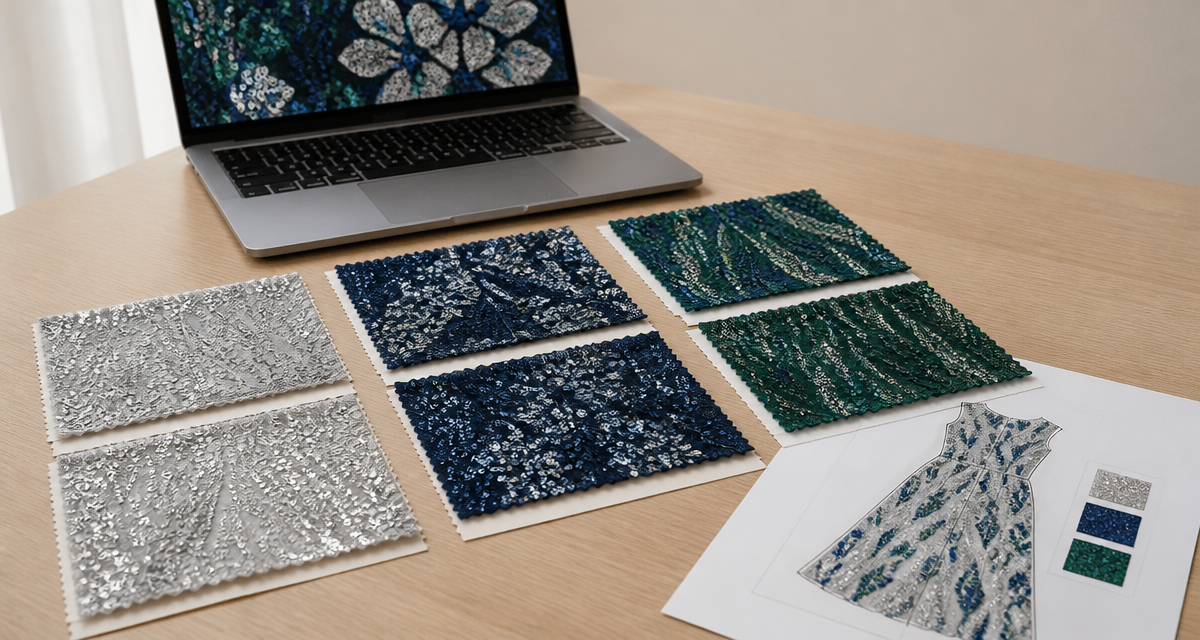
A supplier handover brief is a structured document that gives a manufacturer everything needed to quote, sample and produce a custom embroidered fabric without further clarification. It combines four groups of information.
- The design intent. What the fabric is for, which collection it belongs to, and what the customer will see.
- The technical specification. Ground fabric, motif size, repeat, placement, colour references and finished width.
- The commercial frame. Target quantity, delivery window and any packaging requirement you already know.
- The approval path. Who signs off, what a sample must show, and how revisions will be numbered.
When one of those groups is missing, the factory fills the gap with an assumption. Assumptions are the root of most sampling rework.
How to Build a Supplier Handover Brief in Seven Steps
Build the brief in this order so each section can reference the one above it.
- Write a one-paragraph purpose statement. State the end product, the market and the visual effect you want. Keep it to three or four sentences.
- Attach the technical drawing. Show the motif, the repeat and the placement on the garment or panel. Mark the repeat direction clearly.
- Name the ground fabric. Record the construction, yarn and finished weight, and attach the physical swatch reference you approved.
- Set the colour references. Give thread and component references for every colour in the motif, not just the dominant one. Note any colour that must match a previous order.
- Define the sample expectation. State what the first sample must demonstrate, such as repeat alignment, motif size and edge behaviour.
- List the commercial frame. Record the target quantity, the delivery window and the packaging method, and mark anything still open.
- Name the approval contacts. Give one decision-maker on each side and state the revision numbering rule.
Supplier Handover Brief Sections and Owner
Assigning an owner to each section keeps the brief accurate and stops it becoming a general wish list.
| Section | Owner | What good looks like |
|---|---|---|
| Purpose and end use | Design lead | Three or four clear sentences, no marketing language |
| Technical drawing | Design or technical | Motif, repeat and placement marked with dimensions |
| Ground specification | Product developer | Construction, yarn and weight, plus approved swatch |
| Colour references | Design lead | Every colour listed with a physical reference |
| Sample expectation | QC or technical | Named features the sample must demonstrate |
| Commercial frame | Sourcing or buying | Quantity, window and packaging, with open items flagged |
| Approval path | Project owner | One decision-maker per side and a revision numbering rule |
Keep one owner per section. Shared ownership is how a brief ends up with two contradictory colour references.
Supplier Handover Brief Check Fields
Work through these fields before you send the brief. Each one has caused a delay on a real custom embroidery project at some point.
- Project and collection name. Record the internal name so correspondence stays traceable.
- End product and market. Record what the fabric becomes and where it will be sold.
- Motif and repeat size. Record measured dimensions, not a description.
- Repeat direction. Record the direction so the supplier can set the machine correctly.
- Placement rules. Record how the motif sits at edges, seams and hems.
- Ground construction and weight. Record both, and attach the approved swatch reference.
- Colour list with references. Record every colour and its physical reference.
- Finished width. Record the usable width required after finishing.
- Sample expectation. Record what the first sample must prove.
- Quantity and delivery window. Record the target and mark anything unconfirmed.
- Packaging requirement. Record roll, fold or flat-pack preference.
- Approval contacts. Record one decision-maker per side.
- Revision rule. Record how versions are numbered and named.
- Open items list. Record anything still undecided so nobody assumes an answer.
An open items list is not a weakness. It is better to state that a colour is undecided than to let a supplier choose one on your behalf. If you are still assembling the commercial side, our guide to preparing an RFQ for custom sequin fabric covers the quoting inputs.
Handling Supplier Handover Brief Revisions
Custom embroidery always passes through more than one version. Protect the process with three simple rules.
- Number every version. Use a clear sequence such as V1, V2, V3 and never reuse a number.
- State what changed. Start each revision note with the change, not the reason.
- Mark the approved version. Name the approved file in writing and keep the drawing, the swatch and the reference record together.
A named approved version prevents the most expensive error in custom development: producing to a file that was superseded two revisions ago. Our note on digital sampling versus physical approval explains how the two approval routes can work together.
Common Supplier Handover Brief Gaps That Cost Sampling Rounds
Most rework traces back to four gaps. Closing them in the brief costs nothing. Closing them after a sample arrives costs a round of sampling time.
- An undefined repeat direction. A supplier who does not know the direction sets the machine by habit. The result can be technically correct and visually wrong.
- A colour list with only the main tones. Accent colours decide the character of an embroidered motif. Missing references push the supplier toward a nearest match.
- No placement rules. If the brief stays silent on how the motif meets seams and hems, each sample resolves it differently.
- No stated sample expectation. Without a named purpose, the first sample tests whatever the supplier considers important.
Each gap is inexpensive to close and expensive to inherit. A short paragraph in the brief removes all four, and the supplier starts from your intent rather than their habit.
Turning the Supplier Handover Brief into a Repeatable File
A brief that exists only inside one email thread is not a system. Keep it in a shared location, name it consistently with the project and the version number, and link the drawing, the swatch reference and the approval note from the same page.
When the next order for the same quality arrives, the brief becomes the starting point instead of a blank page. Update the fields that changed, issue a new version, and keep the earlier file. That habit makes a repeat order faster than the first one, which is the real return on the work.
Frequently Asked Questions
How long should a supplier handover brief be?
Long enough to remove assumptions and short enough to be read. Most custom embroidery briefs work well in two to four pages plus the drawing and swatch references.
Should I include pricing expectations in the brief?
Include the quantity and delivery frame, and let the supplier quote against them. Putting a target price in the brief can push the supplier toward a cheaper construction rather than the one you specified.
Can I use the same brief for a second supplier?
Yes, and that is an advantage. A clear brief makes quotes comparable, because every supplier is quoting the same specification.
What if the supplier asks for information my brief does not cover?
Add the answer to the brief and issue a new version. Do not answer only in email, because the next person to read the brief will not see it.
Key Takeaways
A supplier handover brief converts a design idea into a specification a factory can build. Cover the design intent, the technical detail, the commercial frame and the approval path. Assign one owner per section, record every check field, and number each revision. Then keep the drawing, the swatch and the approval note together. That habit shortens sampling, protects your launch date and makes your custom embroidered fabric repeatable.
Need Sequin Fabric for Your Next Collection?
We supply sequin, embroidered and decorative fabric for fashion, bridal and event collections worldwide, with sample support before bulk orders.
Request Sequin Fabric Samples
Send us your motif, repeat and ground specification so we can prepare a custom embroidered fabric sample set for your review.
Morris
Phone / WhatsApp: +86 156 3752 5803
Alternative: +86 175 1619 6727
Email: morris@yunfantextile.com
Related reading: sourcing embroidered fabric for fashion collections, preparing a fabric sample review sheet, and approving a fabric sample before bulk production.