Decorative fabric seam strength is the load a stitched seam can carry before it slips, breaks or pulls the fabric apart. For B2B buyers, the practical answer is to test the seam on the production fabric with the production thread, then set a minimum strength in the specification. Decorative fabric fails at the seam far more often than at the cloth, so treat the seam as the critical component and approve it before bulk.
Key Takeaways
- Seams usually fail before the fabric itself, especially on decorated cloth.
- Sequin and bead coverage can cut effective seam strength.
- Stitch type, thread and seam allowance all change the result.
- Test seam strength on the real construction, not on a plain swatch.
- Reinforce stress points such as armholes, waist and side splits.
- Write a minimum strength figure into the specification before bulk.
What Is Decorative Fabric Seam Strength?
Decorative fabric seam strength is the force needed to separate a seam under controlled test conditions. Moreover, it measures the whole joint, not just the thread. The result depends on the fabric, the stitch, the thread and the seam allowance together.
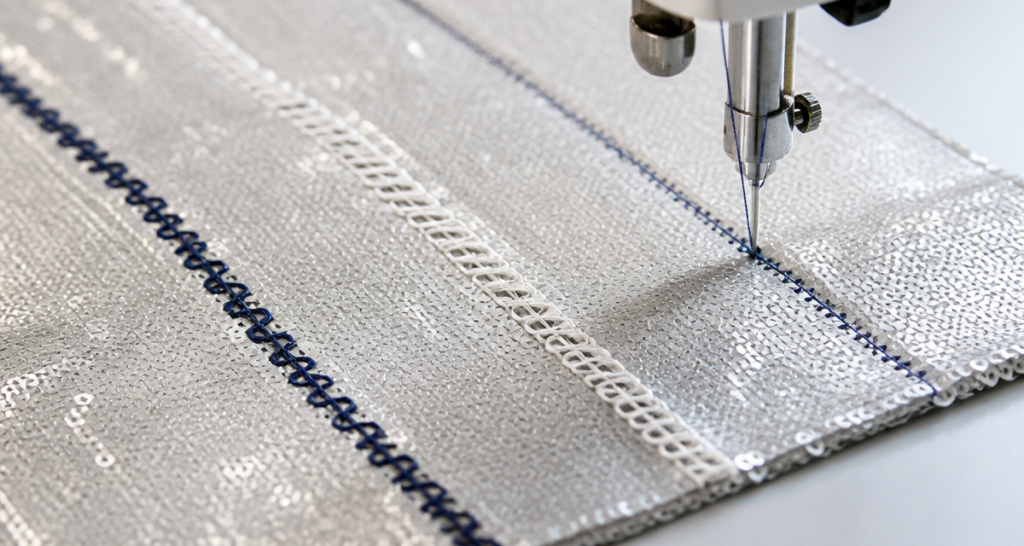
On a decorative fabric, the surface decoration changes everything. Sequins and beads sit above the weave, so the needle must pass through a harder layer. Therefore, the stitch can skip, the thread can abrade, and the seam can carry less load than on a plain cloth.
Seam strength is also directional. A seam across the grain behaves differently from a seam cut on the bias. In practice, a buyer should know which direction carries the most load on the finished garment.
Why Decorative Fabric Seam Strength Matters for B2B Buyers
A weak seam becomes a return. Decorative garments are often used in eveningwear, stagewear and bridal, where the garment must survive movement and repetition. Consequently, a seam that opens once can end a customer relationship.
There is also a production angle. A seam that needs re-sewing slows the line and raises the cost. Meanwhile, a seam that passes at the sample stage but slips in bulk points to a hidden change in thread or stitch density.
Finally, seam quality protects the fabric. A reinforced seam distributes load, so the cloth near the seam does not tear. Therefore, good seam design extends the life of the whole garment, not just the joint.
How to Test and Approve Decorative Fabric Seam Strength
Use a short sequence and repeat it for every fabric and thread combination.
- Cut samples from the production fabric in the load direction.
- Set the stitch type, stitch density and thread to production values.
- Mark a standard seam allowance and sew a straight test seam.
- Condition the sample in the standard atmosphere.
- Apply load across the seam until it slips or breaks.
- Record the peak force and where the failure happened.
- Repeat on at least five samples and note the lowest figure.
- Compare the result with the agreed minimum and approve or adjust.
After that, note the failure mode. However, a thread break means a different fix from a fabric tear, so record both the number and the location.
Purchasing Checklist: Seam Strength Fields to Confirm
- Stitch type and stitch density
- Thread type, ticket number and colour
- Seam allowance in millimetres
- Needle size suited to the decoration
- Minimum seam strength figure
- Direction of test for each seam
- Reinforcement method at stress points
- Seam finish, such as overlock or binding
- Number of specimens tested
- Accept and reject rule for bulk
Moreover, put this list in the specification sheet and repeat it on every order. It links closely to the density questions covered in our guide to embroidery stitch density standards.
Comparing Seam Options for Decorative Fabric
| Seam option | Strength | Best for | Watch point |
|---|---|---|---|
| Plain lock-stitch | Moderate | Light decorative styles | Can slip on stretch cloth |
| Reinforced lock-stitch | High | Stress seams and fitted panels | Can stiffen the seam line |
| Chain-stitch | Moderate to high | Seams that must flex | Unravels if a thread breaks |
| Bound seam | High | Visible and high-wear edges | Adds bulk and cost |
The table above is a guide, not a rule. Therefore, confirm the option on your own fabric and thread before bulk.
Common Seam Strength Problems and How to Fix Them
Seam slippage is the most common defect on decorated cloth. It happens when the weave opens under load. Consequently, increase the seam allowance or add a reinforcing tape along the seam.
Thread breakage is the second issue. It often comes from a needle that is too fine for the sequin layer. Meanwhile, skipped stitches point to a needle that cannot clear the decoration. In addition, a weak seam in bulk may simply mean the thread was changed after approval.
Finally, review the stress points. Armholes, waistlines and side splits carry the highest load, so reinforce them even when the base seam passes. Our note on sequin fabric drape selection explains how movement affects the finished garment.
FAQ: Decorative Fabric Seam Strength
Why do decorative fabrics fail at the seam?
Decoration raises the surface and interrupts the weave. Therefore, the needle and thread work harder, and the seam carries less load than on a plain fabric.
Should I test seam strength on a plain swatch?
No. A plain swatch does not include the sequins or embroidery. Consequently, always test the exact construction that production will sew.
Which seams need reinforcement?
Reinforce the high-load points: armholes, waist, crotch, side splits and any seam that flexes during movement. These points fail first under normal wear.
Can thread choice fix a weak seam?
It can help, but only with matching needle size and stitch density. In practice, treat thread, needle and stitch as one system rather than changing one part.
Conclusion: Set a Minimum Seam Strength
Decorative fabric seam strength is the number that keeps a garment together. Therefore, test the real construction, reinforce the stress points, and write a minimum figure into the specification. Then re-check whenever the thread or stitch changes. This single control prevents the most expensive kind of return.
How to Write Decorative Fabric Seam Strength into the Specification
The specification should state the seam, not only the fabric. Moreover, it should name the stitch, the thread and the minimum strength. Therefore, write the clause once and reuse it for every colour in the range.
Start with the stitch type and the stitch density. Then add the thread type and the needle size. After that, add the seam allowance and the reinforcement method. Finally, add the minimum strength figure and the test direction.
Also, keep a sewn reference. In practice, store one approved seam sample with the specification. As a result, the line can compare a new batch against a physical standard.
Working with a Supplier on Seam Strength
Seam quality is a shared task. However, the buyer must define the load the garment will meet. Therefore, describe the end use, such as eveningwear or stagewear, when you send the enquiry.
Next, ask how the supplier sets the stitch. Meanwhile, ask what happens at the stress points and whether reinforcement is standard. This shows the level of control behind the price.
Finally, agree on a first-article check. Ask for a sewn sample from production, not from a lab. Then approve it in writing before the bulk run starts. Consequently, the whole order follows one proven seam.
Does seam strength change after washing?
It can. Heat and movement can relax the thread and the fabric. Therefore, test the seam again after the planned care cycle if the garment will be washed or dry cleaned.
Is a stronger seam always better?
Not always. A seam that is too stiff can pull the fabric or distort the drape. In practice, aim for a balanced seam that carries the load without stiffening the panel.
When qualifying a decorative fabric for garment or home-textile programs, buyers should request seam-strength data produced under ASTM D1683 rather than a generic tensile figure. That test reports the force required to rupture a stitched seam, and for sequinned and embroidered constructions the critical variable is often seam slippage — the yarns pulling apart alongside the stitch line — rather than thread breakage. Ask the mill to test the exact seam type, stitch density, needle size and thread ticket that will be used in bulk, because a 10 percent change in stitches per inch can shift seam efficiency by several percentage points and quietly reduce the safety margin a buyer has built into the specification.
Source direct on Alibaba - request bulk pricing, specifications, and production details in one place.
View Yunfan Textile on AlibabaRequest Sequin Fabric Samples
Send us your seam specification, thread type and order quantity, and we will prepare a sample set for review. Our MOQ is 200 yards.
Yunfan Textile B2B Contact
Contact: Morris
Email: morris@yunfantextile.com
WhatsApp: +86 156 3752 5803
WhatsApp: +86 175 1619 6727