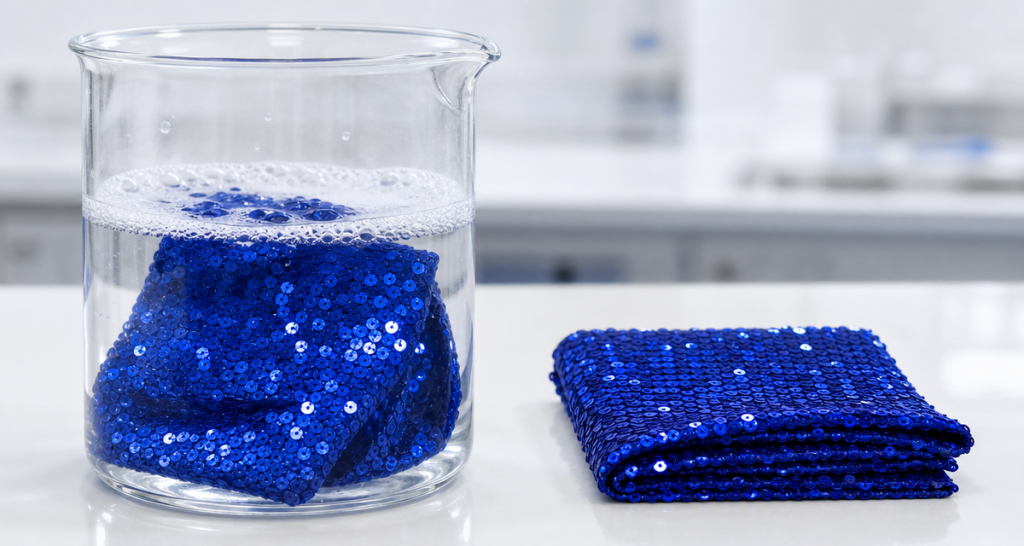
Sequin fabric chemical resistance is the ability of the base cloth, the sequin film and the bonding method to survive contact with cleaning agents, perspiration, cosmetics and alcohol without losing shine, adhesion or colour. The procurement answer is to name the chemicals your market actually uses, then test them on production cloth instead of relying on a general durability claim. A sequin panel can pass a colour fastness test and still fail in service because the adhesive, not the dye, was the weak point.
This guide sets out the chemistry that matters, the test sequence to request, and the order fields that prevent a bulk failure discovered only after installation.
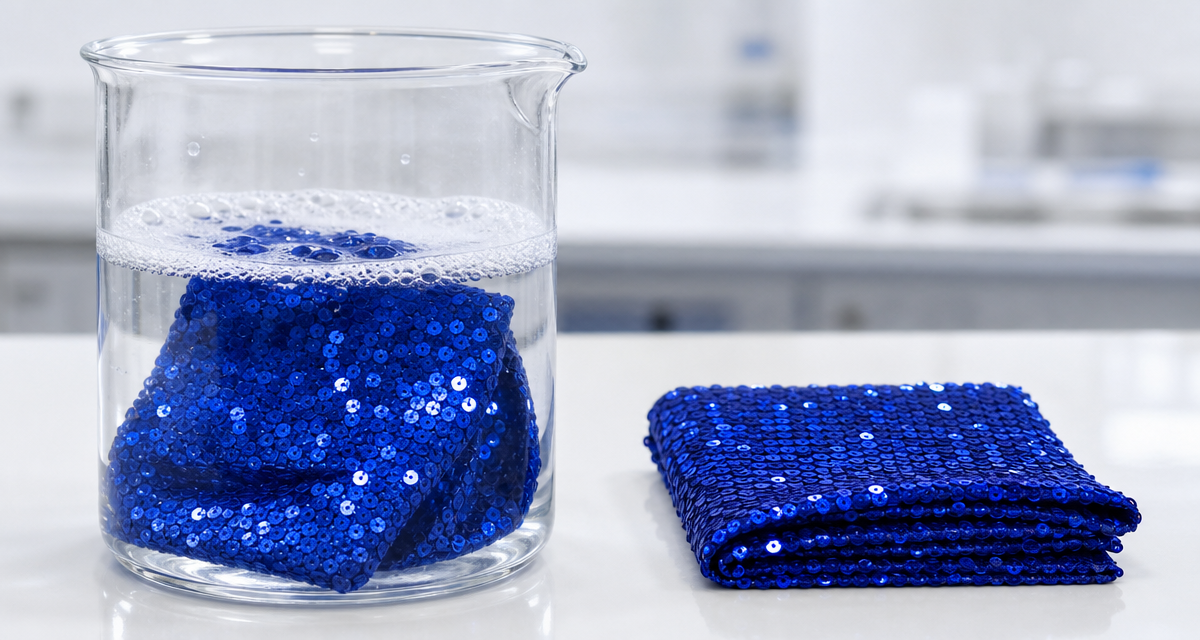
What Is Sequin Fabric Chemical Resistance?
Chemical resistance describes how a decorative textile responds to substances it meets in normal use. For sequin fabric, three separate layers must each survive: the face of the sequin, the adhesion between sequin and thread or film, and the base mesh itself.
The sequin face is usually a metallised polyester film or a coated PVC disc. Cleaning agents can dull the coating, and solvents can cloud it. The bond is vulnerable because adhesives and transfer films soften in different solvents. The mesh base reacts differently again, since some chemicals attack synthetic fibre while leaving the sequins untouched. A buyer who tests only the sequin face, or only the base, tests half of the problem.
Key Takeaways
- Test the whole construction, not a single component.
- Identify the real chemicals in your market: cleaning sprays, alcohol, cosmetics and perspiration.
- Film-bonded sequins are more chemically sensitive than stitched sequins.
- Record concentration and contact time alongside every result.
- Re-test after any change of film supplier or adhesive batch.
Which Chemicals Matter Most
Chemical exposure in decorative textiles comes from a small, predictable group of substances. Ranking them by realistic frequency helps you spend your testing budget well.
1. Aqueous cleaning agents
Soap, detergent and general-purpose surface cleaners are the most common contact chemicals for table linen, cushions and wall panels. The risk is not usually the surfactant itself but the pH, since alkaline cleaners can dull metallised film over repeated cycles.
2. Alcohol-based sanitisers and sprays
Alcohol evaporates quickly but it can soften adhesives and cloud coated film. High-frequency contact in hospitality settings makes this one of the most important chemicals to test for event and contract work.
3. Cosmetics, oils and perspiration
For apparel and costume use, skin contact introduces oils, salts and cosmetic ingredients. These act slowly but continuously, and they attack the bond line at the edge of each sequin, where stress is already highest.
4. Solvent-based spot cleaners
Spot removers are the most aggressive substances a decorative textile is likely to meet. If your care instructions permit solvent cleaning, test it explicitly, because a film bond may release long before the sequin face shows any change.
5. Atmospheric exposure
Salt air, humidity and airborne pollutants slowly degrade coatings in coastal and industrial installations. This is a long-term effect, so it is normally covered by accelerated ageing rather than a simple immersion test.
How to Test Sequin Fabric Chemical Resistance: Step by Step
- List the contact chemicals. Write down every product the end use will realistically meet.
- Cut matched swatches. Take three swatches per chemical from the production roll.
- Record the baseline. Photograph each swatch and note gloss, colour and bond condition.
- Apply the chemical. Use a defined concentration and a fixed contact time, typically from a few minutes to several hours.
- Rinse and dry. Follow the care method your label will state.
- Assess three layers. Check the sequin face, the bond line and the base mesh separately.
- Repeat the cycle. Run several cycles, because cumulative damage is what customers actually experience.
- Compare against a control. Judge results against the untouched swatch, not against memory.

Stitched Sequins vs Film-Bonded Sequins
| Property | Stitched sequins | Film-bonded sequins |
|---|---|---|
| Chemical exposure surface | Sequins and thread only | Sequins, adhesive and base |
| Typical failure mode | Thread abrasion | Bond release or softening |
| Solvent sensitivity | Low to medium | High |
| Heat sensitivity | Medium | High |
| Best use | Apparel, hospitality, events | Flat decorative panels |
For any product likely to meet solvent spot cleaners, stitched construction is the safer default. Film bonding remains efficient for flat panels that are cleaned gently, provided the adhesive is tested against the actual cleaning product.
Order Fields for Chemical Resistance
| Field | Example value | Why it matters |
|---|---|---|
| Contact chemicals | Detergent, alcohol, perspiration | Defines the test set |
| Concentration and time | Stated per chemical | Makes results reproducible |
| Cycles | Minimum of three | Captures cumulative damage |
| Assessment | Face, bond and base | Prevents partial testing |
| Change control | Re-test on film or adhesive change | Protects repeat orders |
FAQ
Is colour fastness the same as chemical resistance?
No. Colour fastness measures dye retention. Chemical resistance also covers adhesion, gloss and base integrity, so a fabric can pass one and fail the other.
Can I rely on a supplier's general durability statement?
A general statement is a starting point, not evidence. Ask for the specific chemicals tested, the concentration, the contact time and the number of cycles.
Why do bonded sequins fail in alcohol?
Many adhesives soften in alcohol. The sequin face may look unchanged while the bond behind it has already weakened, so the failure appears as shedding rather than staining.
Should I test after every production run?
Test at the start of a programme and after any change of film, adhesive or base supplier. Between those points, keep a reference swatch and compare visually each lot.
Do sequin fabrics need solvent cleaning labels?
Only if the construction passes the test. If it does not, state a gentle aqueous care method on the label instead, and test that method explicitly.
Risk Areas by Product Type
The same fabric carries different chemical risk depending on what the finished product is and how it is cleaned. Mapping exposure to product type keeps testing focused instead of expensive.
| Product type | Main chemical exposure | Priority test |
|---|---|---|
| Banquet tablecloth | Detergent, food spills, sanitiser | Repeated aqueous wash cycles |
| Event backdrop panel | Dust, occasional spray cleaner | Surface cleaner at low concentration |
| Cushion and upholstery | Spot cleaners, cosmetics | Solvent spot cleaner on the bond line |
| Apparel and costume | Perspiration, cosmetics | Artificial perspiration, extended contact |
| Hospitality drapery | Cleaning sprays, humidity | Aqueous cycles plus humidity ageing |
Two habits make these tests useful. First, always photograph the control swatch at the same time as the exposed swatch, because gloss loss and slight dulling are easy to overstate from memory. Second, keep the exposure record with the order file, so a repeat order can be tested the same way rather than reinvented from scratch.
It also pays to separate a cosmetic change from a functional failure. A slight loss of gloss may be acceptable on a decorative backdrop, while a softened bond line is never acceptable on any product, because it leads directly to shedding. When a test produces a borderline result, judge it against the specific end use rather than against a single company-wide standard.
Reading a Chemical Resistance Report
A supplier report is only useful if it states four things: the chemical, the concentration, the contact time and the number of cycles. A general statement such as resistant to cleaning agents cannot be compared with another supplier's result, and it cannot be used to defend a claim later.
Ask for the report to name the layers assessed as well. A result that covers only the sequin face does not tell you whether the adhesive survived, and adhesive failure is the most common reason a sequin panel fails in service rather than in the sample room. Where the report shows a pass, ask for the control swatch reference so the same judgement can be repeated on a later production run.
Finally, treat any change of film, adhesive or base supplier as a trigger for retesting, because chemical resistance belongs to the whole construction rather than to the sequin alone. Repeat orders placed months apart can behave differently if a component quietly changed in between.
Conclusion: Test the Chemistry Your Customer Will Use
Sequin fabric chemical resistance is not a single property, and it cannot be inherited from a data sheet. List the chemicals, test all three layers, repeat the cycles and hold the result against a control swatch. Buyers who do this stop discovering bond failures after the panels are already installed. Our sequin fabric range and quality control process are built around testable parameters rather than broad claims.
Want to test your specific cleaning products on production cloth? Request Sequin Fabric Samples and tell us which chemicals your market uses, and we will send matched swatches with a reference control.
Source direct on Alibaba - request bulk pricing, specifications, and production details in one place.
Contact Morris at morris@yunfantextile.com, or message on WhatsApp: +86 156 3752 5803 or +86 175 1619 6727.