Embroidery metallic thread quality decides two things at once: how bright a motif reads on the finished garment, and how often the machine stops. The procurement answer is to qualify thread by construction, not by appearance alone: confirm the core, the coating, the tensile behaviour and the recommended tension range, then run the actual motif at production speed before you commit to bulk. Bright thread that breaks every few hundred stitches costs far more than a slightly duller thread that runs clean for the whole order.
This guide compares the main metallic thread types, explains what drives breakage, and gives a qualification sequence you can run before sampling is approved.
What Is Embroidery Metallic Thread Quality?
Embroidery metallic thread is a composite yarn: a fine metallic or metallised film wrapped around, or laminated to, a textile core. Quality describes how well that composite survives the mechanical stress of high-speed stitching.
Three attributes define it. Tensile strength is how much pull the thread withstands before it fails. Abrasion resistance is how well the metallic layer survives friction through the needle eye and the fabric. Tension window is the range of machine tension in which the thread runs without looping or breaking. A thread with a narrow tension window is difficult to run on a multi-head machine, even if its tensile strength is high.
Key Takeaways
- Metallic thread is a composite, so both the core and the coating matter.
- A wide tension window is more useful on multi-head machines than peak tensile strength.
- Needle size and eye geometry cause more breakage than thread quality alone.
- Heat build-up at high stitch speeds degrades the metallic layer.
- Store metallic thread sealed, because humidity damages it faster than age does.
Metallic Thread Types Compared
| Type | Construction | Runability | Best use |
|---|---|---|---|
| M-type metallic | Metallised film laminated to a support | High | Dense fills, high-speed production |
| V-type metallic | Metallic film wrapped with a binder | Medium | Decorative detail, medium density |
| Metallic-core polyester | Polyester core with metallic wrap | High | Wearable garments, flexible motifs |
| Soft-touch metallic | Fine metallic layer, low twist | Medium to high | Delicate grounds, soft hand feel |
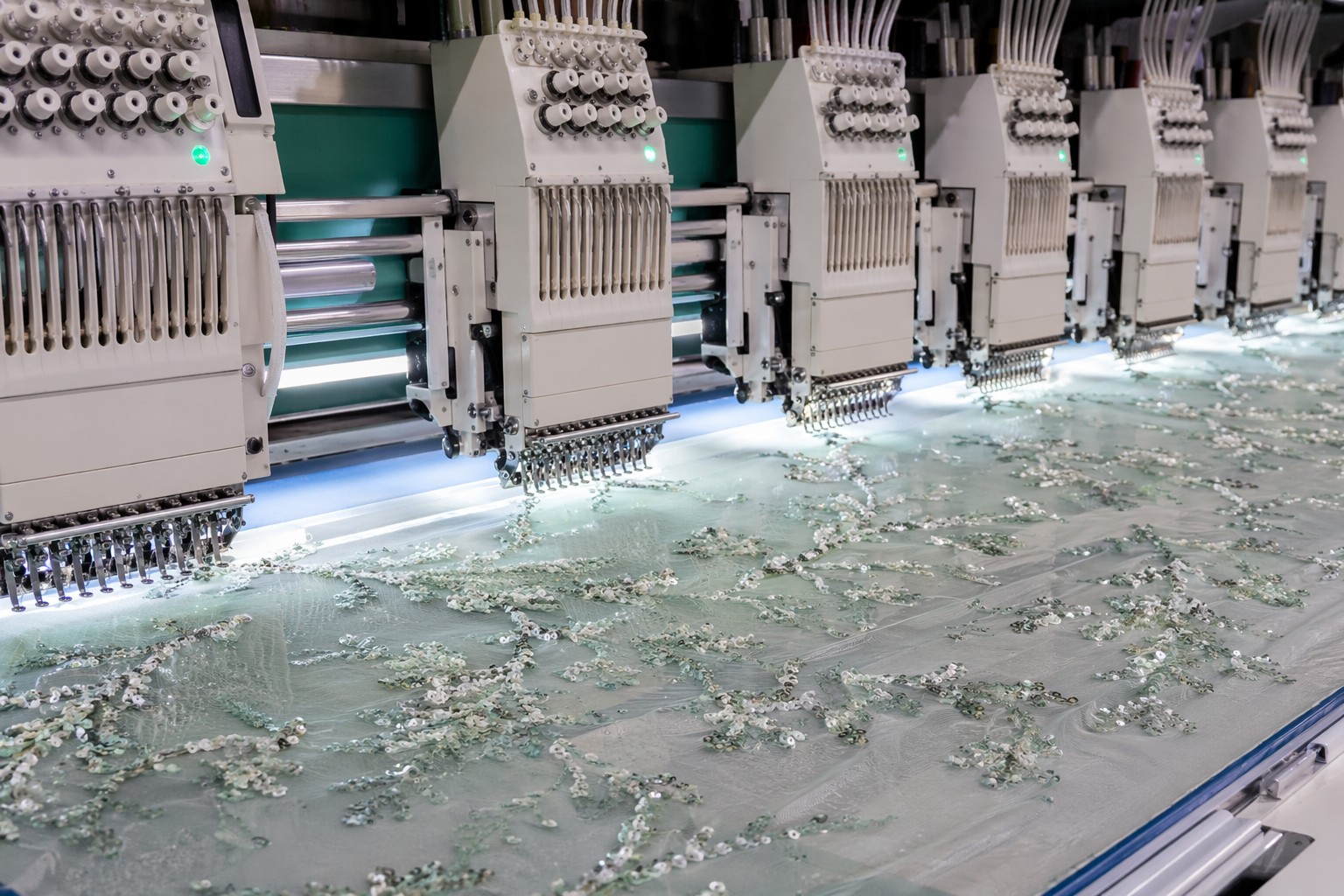
Skill level and machine type both matter. A thread that runs cleanly on a single-head machine can struggle on a 40-head production line, because forty heads multiply every tension irregularity. That is why qualification must happen under production conditions.
What Drives Metallic Thread Performance
Three attributes define thread quality, but six conditions decide whether that quality reaches the fabric.
1. Core and coating construction
A continuous-film metallic layer reflects light consistently but cracks if it is bent too sharply. A wrapped construction flexes more easily but can unwind under abrasion. The correct choice depends on motif density and on how the finished piece will be worn or washed.
2. Tension balance
Metallic thread needs a wider, lower tension setting than spun thread. Top tension that is one step too high produces shredding and skipped stitches, which are often blamed on the thread rather than the setting.
3. Needle size and eye condition
The needle eye is the smallest aperture the thread passes through, and it is where most abrasion damage occurs. A damaged or undersized eye shreds the metallic layer within hundreds of stitches. Match needle size to thread weight and replace needles on a fixed schedule.
4. Stitch speed and heat
Friction generates heat at the needle, and heat softens the binder that holds a metallic film in place. Lowering maximum speed slightly often eliminates breakage that no tension change can fix.
5. Storage and humidity
Metallic thread oxidises and tarnishes, especially in humid conditions. Sealed storage with desiccant protects both the coating and the core, and older stock should be tested rather than assumed to be good.
6. Design density and pathing
Dense fill areas force hundreds of consecutive stitches through the same zone, which raises both heat and abrasion. Splitting a dense metallic area into two passes, or reducing density slightly, extends thread life and improves stitch definition.
How to Qualify a Metallic Thread: Step by Step
- Confirm the construction. Ask for core type, coating type and nominal linear density.
- Request the tension window. Get the recommended upper and lower machine tension values.
- Match the needle. Confirm the needle size and eye specification for the thread weight.
- Run a stitch sample. Sew at least one metre of a dense column at production speed.
- Run the real motif. Use the final file, because density distribution drives breakage.
- Wash or dry-clean one sample. Follow the care label and assess tarnish and fraying.
- Record breakage. Count machine stops per thousand stitches and set an acceptance limit.
- Freeze the parameters. Write thread reference, tension, needle and speed into the specification.
Inspection Checklist for Metallic Thread Work
| Check | What to look for | Typical cause of failure |
|---|---|---|
| Coverage | Even metallic reflection across the motif | Inconsistent tension |
| Breakage | Stops per thousand stitches | Small needle eye or high speed |
| Shredding | Loose metallic filaments on the face | Abrasion at the needle |
| Tarnish | Dull patches after washing | Humidity damage or poor coating |
| Edge definition | Crisp satin edges on the motif | Density or sequence error |
Order Fields for Metallic Thread Quality
| Field | Example value | Why it matters |
|---|---|---|
| Thread reference | Supplier type and lot code | Enables exact repeat orders |
| Tension setting | Stated range for the machine | Prevents shredding |
| Needle specification | Size and eye type | Controls abrasion |
| Maximum stitch speed | Stated stitches per minute | Limits heat build-up |
| Breakage limit | Stops per thousand stitches | Makes acceptance objective |
FAQ
Why does metallic thread break more than polyester thread?
Its metallic layer has less elasticity than textile fibre, so it fails earlier under the same tension and abrasion. Lower tension, a larger needle eye and reduced speed usually resolve most breakage.
Can I run metallic thread on any embroidery machine?
Most machines can run it, but multi-head machines demand a wider tension window. Confirm performance on the actual machine before approving bulk.
Does metallic thread need special storage?
Yes. Keep it sealed with desiccant and away from humid air. Tarnish from humidity is permanent and cannot be polished out of a stitched motif.
Is soft-touch metallic thread less durable?
Softer constructions flex more easily but can be more sensitive to abrasion. Test them on the real motif and care method before choosing them for a hard-wearing product.
Should I test leftover thread from a previous order?
Yes, especially if it has been open for some time. Retest tension and breakage rather than assuming the original parameters still apply.
Common Metallic Thread Defects and Their Causes
Four defects account for most metallic thread complaints on bulk embroidery orders. Recognising each one separates a thread problem from a machine or design problem.
Repeated breaks at the needle. Usually a small or worn needle eye, or a tension setting at the very top of the window. Replace needles before you change the thread specification, because the needle is the cheaper variable to correct.
Skipped stitches in dense fills. Typically a tension window or density issue rather than a thread fault. Reduce density slightly, or split the fill into two passes, and re-run the same motif.
Metallic filaments fraying on the face. Caused by abrasion at the needle and by running at maximum speed. Lowering the stitch speed is often enough to remove it entirely.
Dull or tarnished patches after washing. A storage or coating issue. Confirm the thread has been kept sealed, and check the care method against the thread's own recommendation.
Finally, compare defect patterns across a full production run rather than a single panel. A breakage cluster that appears at the same point in every motif usually points to a design or pathing issue, while breakage that spreads randomly across panels points to the thread, the needle or the ambient humidity. Recording where the machine stopped, not only how often, turns a vague complaint into a specific correction that a technician can act on.
Conclusion: Qualify Thread the Way You Qualify Fabric
Embroidery metallic thread quality is a production variable, not a cosmetic choice. Confirm the construction, run the real motif at production speed, count breakage and freeze the parameters in the order. Buyers who do this get consistent shine and fewer machine stops, and they stop chasing defects that were designed into the process from the start. Our embroidery fabric range is quoted with thread and needle recommendations attached, and our embroidery technology notes explain how those settings interact with dense motifs.
Want to compare metallic thread on your own motif? Request Sequin Fabric Samples and send us your artwork and machine type, and we will return stitched panels with the thread reference and settings used.
Source direct on Alibaba - request bulk pricing, specifications, and production details in one place.
Contact Morris at morris@yunfantextile.com, or message on WhatsApp: +86 156 3752 5803 or +86 175 1619 6727.