

Global buyers sourcing sequin fabric for 2026 are looking beyond surface sparkle. The category has matured into a performance-driven business where texture, sustainability, and measurable quality decide which suppliers win repeat orders. This guide covers the trends shaping wholesale demand, the specifications that prevent costly reorders, and the quality-control checks every procurement team should run before bulk production. Browse our sequin fabric category to compare mesh, stretch, and recycled options side by side before you send your first inquiry.
2026 Sequin Fabric Trends: 3D Textures and Recycled Materials
The biggest shift in 2026 is texture. Flat, uniform sparkle is giving way to dimensional, layered finishes that catch light from every angle. 3D sequin fabrics are the fastest-growing segment in the category, driven by stage costumes, festival fashion, swimwear accents, and premium evening wear, where movement and depth matter as much as shine. Our premium 3D sequin fabric — multi-color, lightweight, and stretchable shows how far the segment has moved from stiff, flat lamé. The stretchable base improves comfort for dancewear, while the multi-color finish creates the depth buyers expect at a premium price point.
Sustainability is moving from a differentiator to a default requirement. European and North American retail programs increasingly ask for GRS certification and rPET (recycled polyester) bases. Recycled sequin fabrics cut virgin polymer consumption, and GRS traceability gives brand teams the documentation they need for credible sustainability claims. Ask for the certificate number and its scope; a paper claim without certification is not a claim you can pass to your own customer. Buyers who verify recycled content at the sample stage avoid compliance surprises in bulk.
Wholesale and Custom Applications: From Costumes to Backdrops
2026 sourcing demand falls into two broad use cases: apparel and accessories — costumes, dancewear, rave wear, swimwear, and festival outfits — and decor and events — backdrops, drapery, table styling, and photo-booth walls. For apparel, stretch, hand feel, and sequin attachment under movement are critical; for decor, width, weight, and fire-retardant options matter more. A neon glow sequin fabric in 12 mm sequins answers the rave and cosplay market, while an eco-glitter sequin backdrop targets wedding and party production where recyclability is part of the event pitch.
Custom programs — branded colors, custom sequin sizes, printed bases, and bespoke widths — typically carry a minimum order quantity and a development cycle. Treat customization as a planning exercise, not a last-minute request. Agreeing on the specification sheet, strike-off, and pre-production sample early keeps custom runs on schedule and protects your margin. For event buyers, ask whether the backdrop width can be joined seamlessly for larger installations.
Key Specifications Buyers Must Verify: GSM, Width, and Sequin Size
Before bulk ordering, lock down the specification sheet. The numbers that prevent most disputes are GSM, finished width, sequin size, and base construction. GSM determines drape and weight: a costume mesh may run 120–180 gsm, while a decor fabric will be substantially denser. Confirm the finished width in centimeters — 130 cm and 150 cm are the most common for apparel and event fabrics — and remember that sequin rows reduce the usable sewing width. Sequin diameter (6 mm, 10 mm, 12 mm, or larger), shape (round, hexagonal, star), and material (PET, metalized, acrylic) drive both the look and the cost. Our chameleon color-shift sequin fabric, for example, uses an iridescent finish that requires careful dye-lot control to keep the color shift consistent across rolls.
Quality Control: Color Difference, Adhesion, and Sample-to-Bulk Consistency
Color difference (色差) is the most common claim in sequin fabric disputes. Sequins are dyed, coated, or metalized in batches, so adjacent rolls can drift. Request a dye-lot number on every roll, check goods under standard D65 lighting, and compare the bulk shipment against the locked sample before cutting. A tolerance statement — for example, no more than 0.5 CIELAB ΔE — makes the acceptance criteria objective instead of subjective.
Adhesion (attachment strength) is equally critical for stretch and performance fabrics. Sequins that pop off during cutting, sewing, or the first wash generate costly claims. Ask the factory for peel-force or drop-test results, and require an inline check during production. Finally, protect sample-to-bulk consistency: the pre-production sample is the contract reference. Photograph it, archive a physical swatch, and confirm that bulk uses the same sequin batch, base dye lot, and finishing recipe as the approved sample.
Lead Time, Packaging, and Supplier Audits
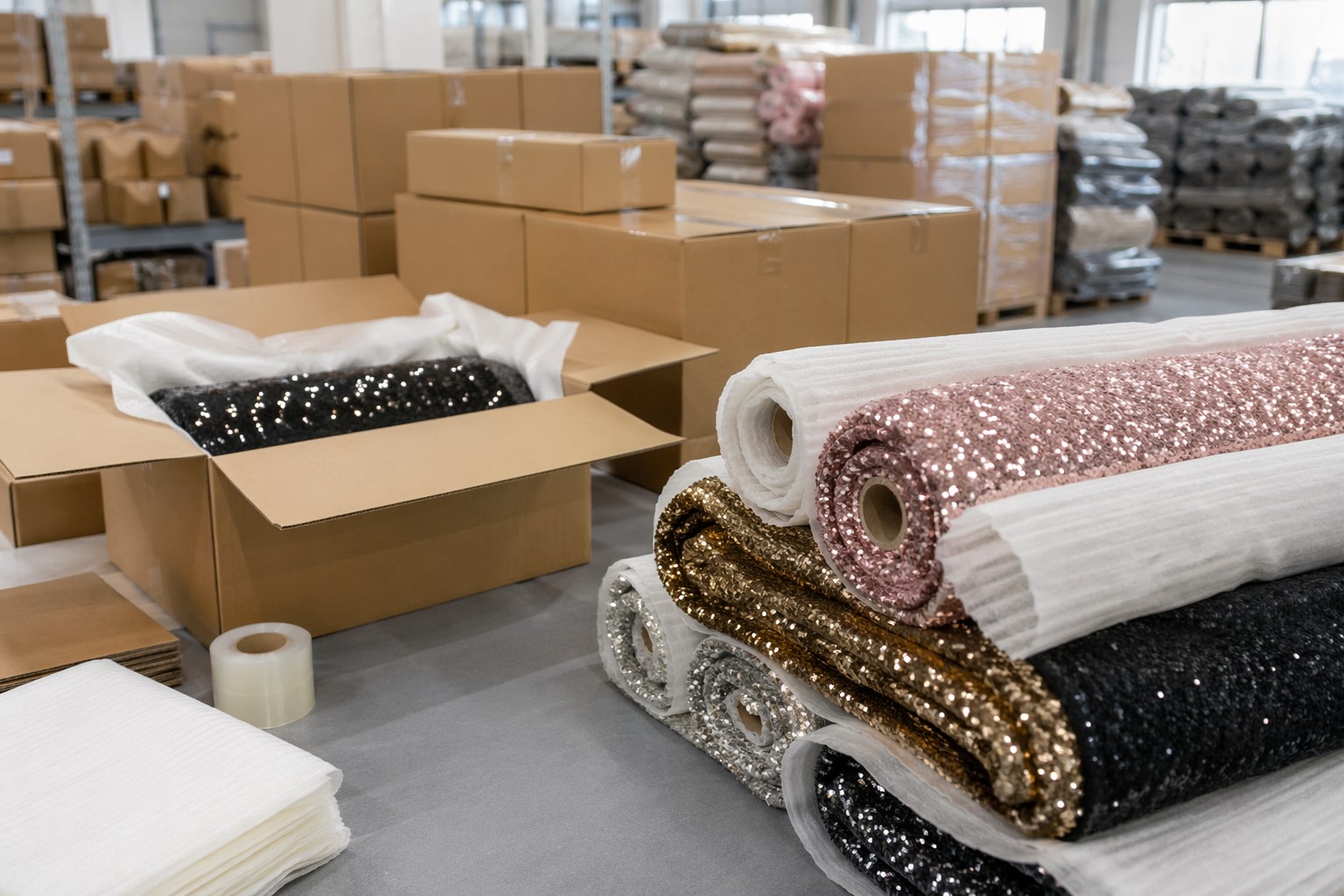
Standard production for custom sequin runs is usually 15–30 days plus freight; stock colors ship faster. Build buffer time for peak season (Q3) and for holiday-event decor, where demand spikes are predictable. Packaging is part of quality: rolls should be wrapped in protective film with edge protection, packed to avoid crushing, and labeled with style, color, dye lot, and roll length. Moisture-barrier liners matter for sea freight.
Supplier audits close the loop. Visit or remotely audit the factory to verify dye-lot records, sequin adhesion test results, GRS certification, and sample archives. A supplier that can show dated QC records and traceable raw materials is a supplier that will meet your lead times and tolerances. Combine these checks with a clear specification sheet, and 2026 sequin sourcing becomes predictable — from first sample to delivered bulk.
Source sequin fabric with confidence in 2026 — request swatches or talk to our sourcing team today.
Visit Alibaba Gold Supplier
Request Free Swatches / Contact Us
Contact Yunfan Textile for B2B Sourcing
🌐 Website: https://www.yunfantextile.com/
📌 B2B Contact: Jessie wendy
📱 WhatsApp/WeChat: +86 175 1619 6727 / +86 156 3752 5803
📧 Email: morris@yunfantextile.com
📧 Email: morris@yunfantextile.com