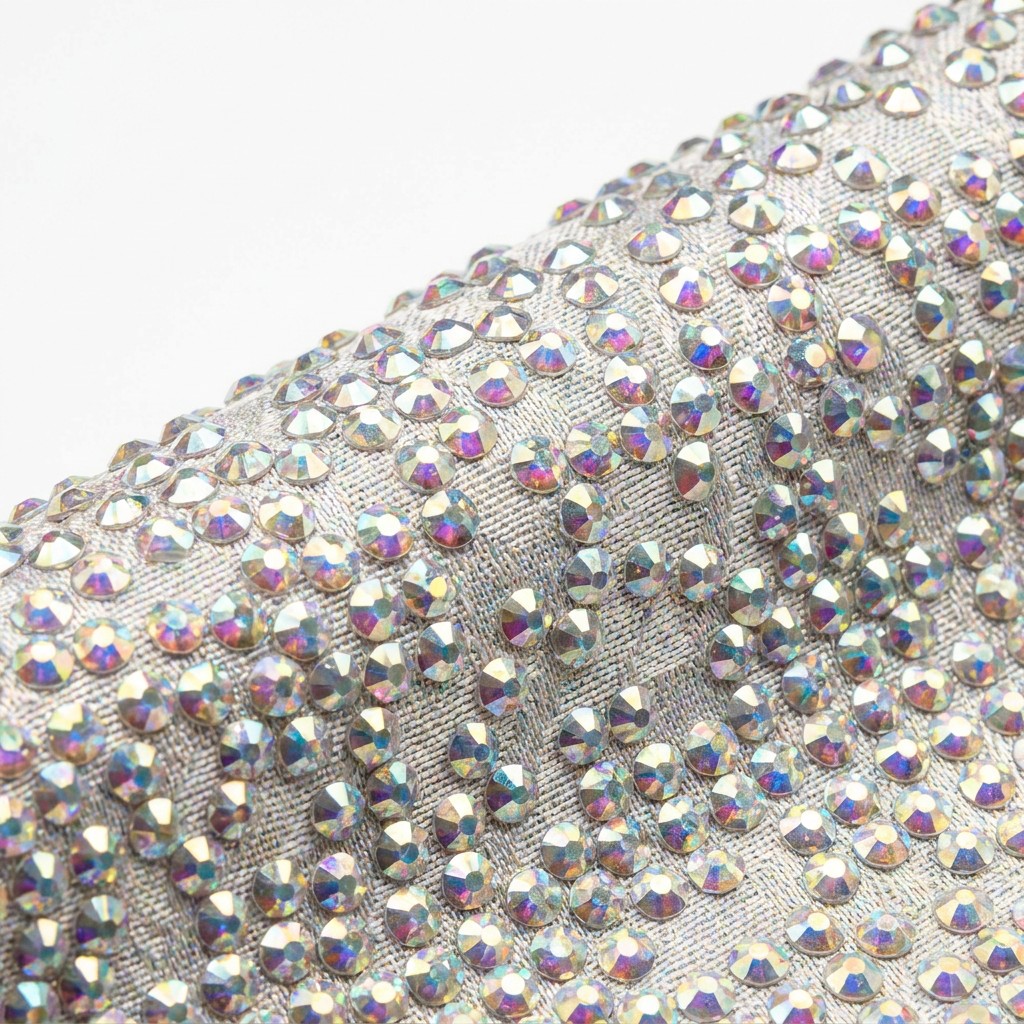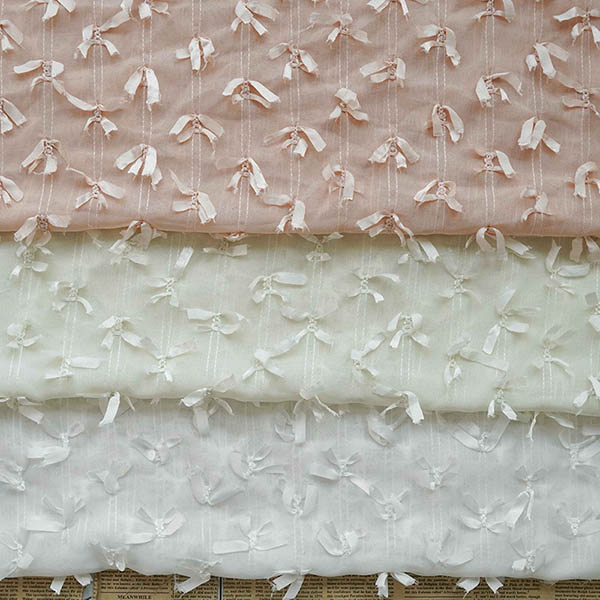
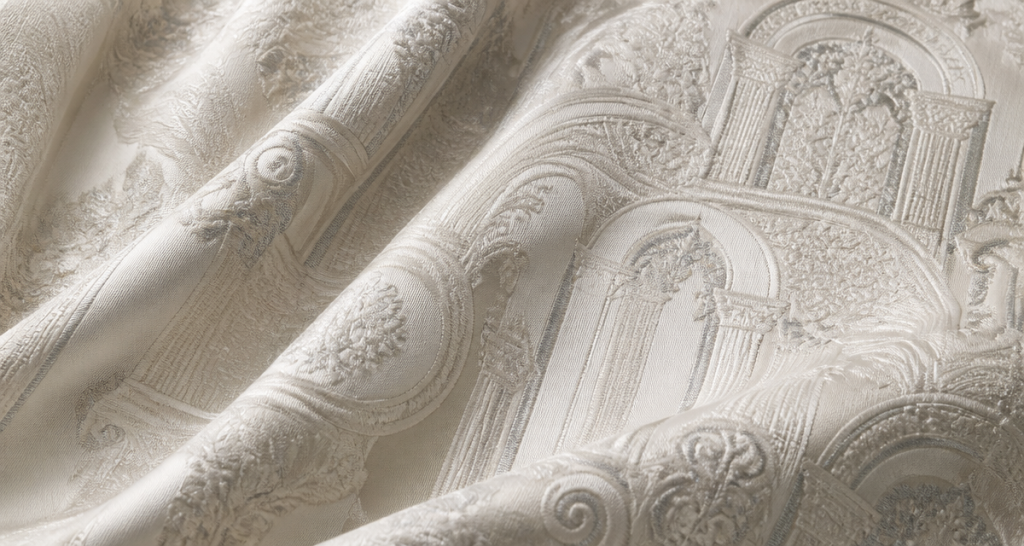
Flat fabrics are taking a back seat in 2026 evening wear. Buyers and designers are turning to jacquard for what print cannot deliver: depth, weight, and a hand-feel that photographs like couture.
Why Texture Is the Defining Detail of 2026 Evening Wear
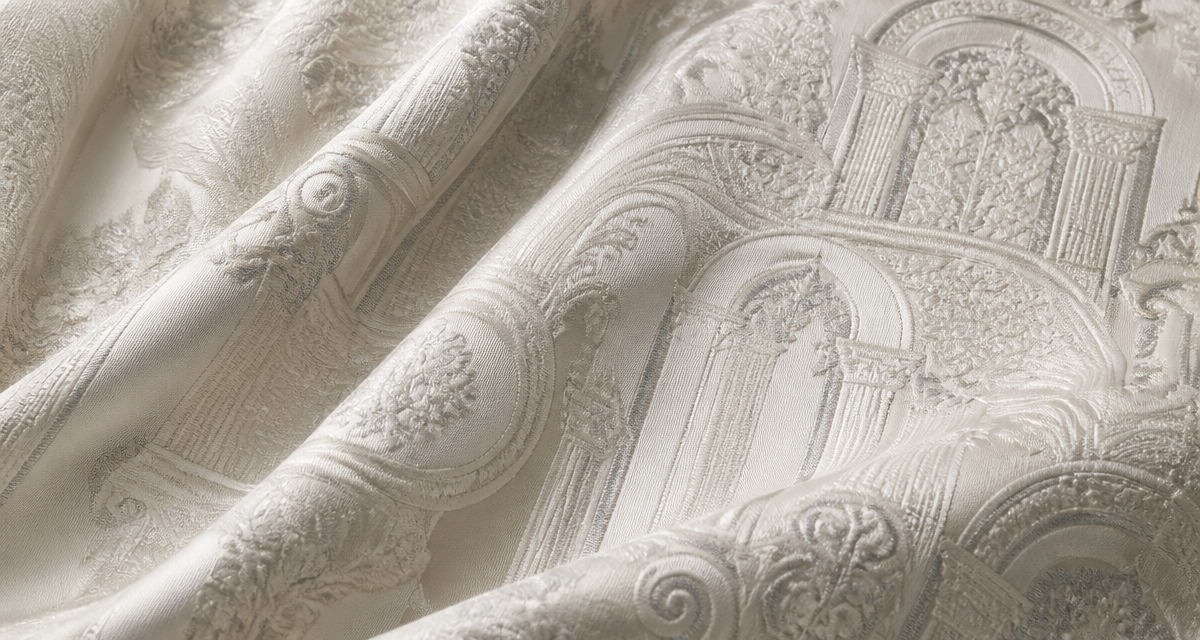
After several seasons dominated by minimal surfaces, the AW26/27 direction rewards tactility. On the runway and in bridal and evening collections, dimensional fabrics carry the investment-piece message — and jacquard is the most direct route. A jacquard pattern is woven into the fabric, not printed on it, so the design has body, shadows, and a surface that changes with light. In a market where customers can feel quality, that physical depth is a purchase driver, not a detail.
The 2026 Jacquard Palette: What Designers Are Ordering
As an evening gown fabric, jacquard in 2026 is moving toward structured florals, architectural geometries, and damask-inspired motifs — executed with modern scale and negative space rather than dense Victorian repeat. Colour stories lean to deep jewel tones, bronze and antique-metal accents, and ink-black grounds with tonal patterning. Buyers are also mixing: jacquard bodices with fluid matte skirts, or jacquard panels on knit bases, balancing ornament with wearability.
How Jacquard Earns Its Place in a Couture Budget
Jacquard costs more per metre than plain or printed fabric — the loom time alone guarantees that. It earns the cost three ways. First, cut-and-sew efficiency: a well-designed jacquard replaces embroidery or beading application labour. Second, perceived value: customers price a jacquard gown by its surface, not its seams. Third, longevity: a woven pattern does not crack, fade, or peel, which protects resale and rental value — increasingly important in luxury markets.
From Mood Board to Metre: Working with a Jacquard Mill
A serious jacquard programme starts with a conversation about construction: fibre content, density, repeat size, and drape. The mill translates this into a woven trial, then a strike-off sample on the actual loom. Because jacquard sampling is slower than printing, plan 2-4 weeks for development before production — and always confirm lead time on the approved sample, not the sales promise. A well-briefed mill will also flag what a swatch cannot show you: how the repeat lands on a garment layout, how the fabric behaves on the bias, and whether the finish needs a final softening or calendering step. These production realities belong in the sampling conversation, because they determine both fabric yield and making cost per gown.
A Practical Checklist for Evaluating Jacquard Suppliers
- Can they weave your motif, or only supply stock patterns?
- Do they control the loom and finishing in-house?
- Can they show strike-offs on your fibre blend before you commit?
- What is their MOQ per colourway, and does it vary by construction?
- Can they match your brand colour across production lots?
- Do they provide a pre-production sample for bulk approval?
Run the same brief with two or three mills and compare strike-offs on the same deadline — the speed and precision of their response is itself a quality signal.
Jacquard Beyond the Gown: Bridal and Accessories
The same weave that powers evening gowns is earning its place in bridal and luxury accessories. Bridal designers use jacquard for ceremony gowns where embroidery budgets run high, replacing hand beading with a woven motif that reads as equally considered. Accessory houses cut jacquard for clutches, headpieces, and shoe uppers, where the raised surface adds grip and structure as well as ornament. If you are already buying jacquard for gowns, the same development can feed an entire category — one motif, one strike-off, several price points.
Conclusion
Jacquard is 2026's texture story, and the brands that win will be the ones who brief, sample, and approve properly. Start the conversation early, and let the loom do the selling.
FAQ
Q: Is jacquard more expensive than embroidered fabric?
A: Per metre, high-quality jacquard can be comparable to mid-range embroidery — and it removes the per-garment application cost. Compare total cost per garment, not fabric price alone.
Q: Can jacquard be made with my own motif?
A: Yes, custom motifs are standard in jacquard weaving. Development typically requires a pattern file, repeat specification, and sample approval before bulk.
Q: What is the MOQ for custom jacquard?
A: MOQ varies by construction, yarn, and loom setup — commonly from a few hundred metres per colourway. Confirm exact numbers after your spec is reviewed.
Q: How long does custom jacquard sampling take?
A: Typically 2-4 weeks for the first strike-off, and longer for complex multi-colour constructions. Bulk lead time is confirmed after sample approval.
Q: Can jacquard be combined with sequins or beading?
A: Yes — sequin jacquard and embroidered jacquard are established premium categories. The base weave provides structure that embellishment sits on beautifully.
Explore Jacquard for Your 2026 Collection
Send your motif and construction requirements — we will confirm weave feasibility, sampling time, MOQ, and lead time before you spend a metre of budget.
Related Sourcing Resources
- 7mm Prismatic Sequin Jacquard Fabric Wholesale – Couture & Millinery
- Chiffon Jacquard Butterfly Embroidery Dress Fabric Wholesale
Sourcing note: MOQ varies by product and customization. Confirm the exact minimum, lead time, and sample details with our team after your specification is reviewed.