Sourcing high-quality custom sequin fabric wholesale requires balancing aesthetic brilliance, substrate tensile strength, lock-stitch durability, and strict production tolerances. For global apparel manufacturers, fashion labels, and theatrical costume designers, purchasing decorative textiles at scale often presents critical operational challenges. For example, buyers frequently encounter needle breakage during high-speed garment stitching, unacceptable sequin detachment under mechanical friction, and inconsistent dye lots between production batches. Furthermore, rigid minimum order quantities from conventional mills restrict emerging fashion lines from launching experimental collections. Therefore, working directly with an integrated manufacturing partner resolves these challenges by providing transparent quality assurance protocols, rapid strike-off sampling, and a standard factory baseline MOQ of 200 yards per custom colorway.
Understanding Custom Sequin Fabric Wholesale Specifications: Substrates, Polymers, and Stitching
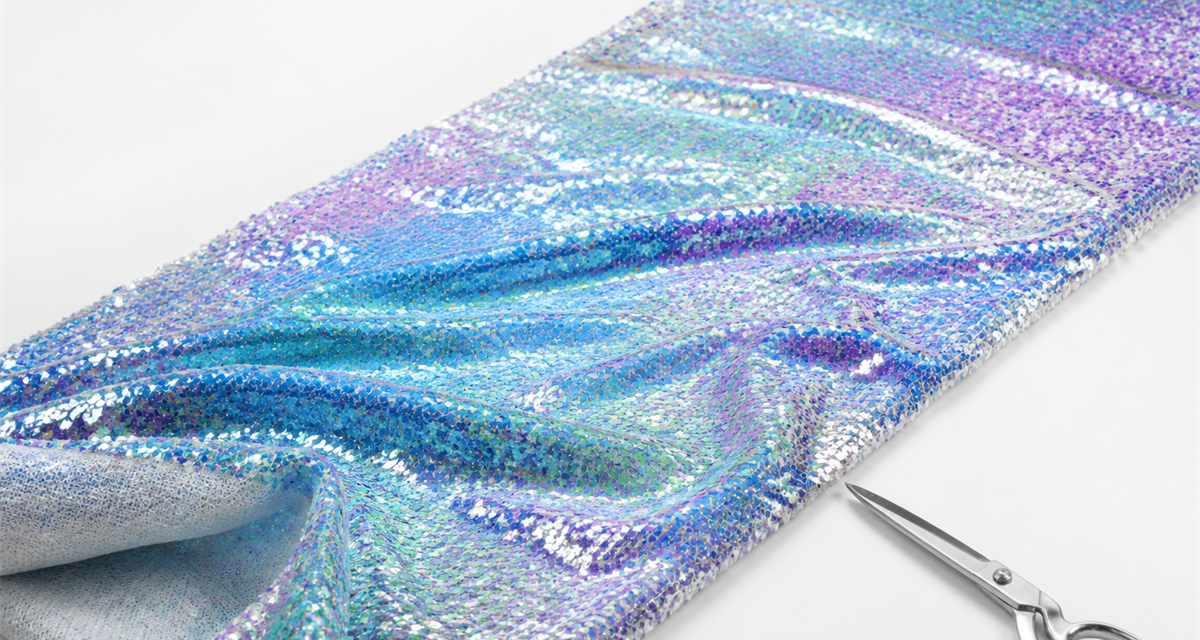
Sequin fabric is an engineered ornamental textile where specialized embroidery machinery locks metallic, matte, iridescent, or holographic polymer discs (spangles) onto a flexible backing. In commercial B2B textile manufacturing, garment drape, stretch recovery, and overall lifespan depend directly on the mechanical harmony between three foundational elements: the backing mesh, the sequin polymer film, and the locking embroidery thread.
1. Base Fabric Substrates
The underlying mesh or backing fabric determines mechanical resilience, stretch performance, and garment drape:
- Polyester Mesh (Tulle / Netting): Manufacturers widely utilize lightweight polyester netting (30–70 GSM) for formal evening wear and bridal gowns. Consequently, this netting provides exceptional tensile strength, breathability, and reliable dimensional stability during pattern cutting.
- 4-Way Stretch Spandex / Nylon Mesh: Mills engineer this substrate using 80–90% nylon and 10–20% elastane. Specifically, performance catsuits, bodycon dresses, and dancewear require this backing to achieve 100% to 150% multidirectional stretch recovery without substrate tearing.
- Woven Satin, Velvet, and Taffeta Backings: Heavier bases (150–280 GSM) serve structured evening jackets, luxury capes, and stage drapery where designers require complete opacity and substantial structural weight. You can explore our complete range of sequin fabric collections across diverse base materials.
2. Sequin Polymer Materials: PET vs. PVC
Selecting the appropriate polymer grade directly prevents surface warping, discoloration, and chemical degradation during garment care:
- PET (Polyethylene Terephthalate): Premium export apparel requires 100% virgin PET film. Moreover, PET sequins withstand high ironing temperatures up to 150°C (302°F), resist commercial dry-cleaning solvents (perchloroethylene), and maintain vibrant UV colorfastness under intense stage lighting.
- PVC (Polyvinyl Chloride): Although PVC offers an economical entry price for short-term festival wear, it softens rapidly above 70°C (158°F). Consequently, PVC discs easily warp during standard steam pressing and can emit synthetic plasticizer odors.
3. Stitching Mechanisms: Lock-Stitch vs. Chain-Stitch
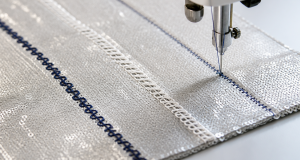
- Multi-Head Lock-Stitching: Computerized multi-head machines intertwine a top thread and a bobbin thread to secure each sequin independently. Therefore, when garment tailors cut through pattern lines, adjacent sequins remain firmly anchored to the backing.
- Continuous Chain-Stitch: High-speed continuous looping methods reduce machine cycle times. However, a single thread rupture during garment assembly can trigger sequential unravelling across an entire row unless the mill reinforces terminal edges with back-tack lock stitching.
Key Takeaways for B2B Custom Sequin Fabric Wholesale Buyers
- Mandate 100% Virgin PET Sequins: Always specify PET polymer over PVC to ensure high thermal resistance and prevent chemical melting during industrial garment pressing and dry cleaning.
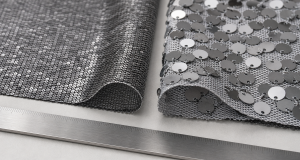
- Clarify Disc Geometry and Spatial Density: Define exact disc diameters (2mm micro-sequins, 3mm, 5mm, or 7mm paillettes), layout spacing (dense fish-scale overlapping versus spaced geometric motifs), and surface finish.
- Require High-Tenacity Core-Spun Thread: Insist on 40s/2 or 60s/3 core-spun polyester thread to eliminate sequin detachment during automated fabric spreading and high-speed sewing.
- Standardize Laboratory Dips and MOQs: Partner with flexible B2B suppliers offering a realistic 200-yard MOQ per custom shade, supported by physical strike-off deliveries within 3 to 5 business days.
5-Step Custom Sequin Fabric Wholesale Procurement Workflow
Executing a seamless custom sequin fabric wholesale purchase requires disciplined technical communication between brand developers and textile mill engineers. Follow this verified five-stage workflow to minimize manufacturing errors:
- Step 1: Technical Specification Submission
In the initial stage, buyers submit comprehensive technical packs containing base mesh composition, total target GSM, clear embroidery width (e.g., 130 cm usable width on 150 cm overall width), sequin diameter, and standardized Pantone/CSI color codes. - Step 2: Strike-Off & Lab Dip Approval
Next, our factory digitizes the CAD embroidery pattern and produces a 1-yard strike-off sample on production-scale multi-head machinery. Quality engineers inspect this strike-off in standard D65 light booths to evaluate color matching, luster, and substrate hand feel. - Step 3: Machine Setup & Tension Calibration
Before initiating bulk embroidery, technicians pre-set the base mesh under electronic tension control to eliminate fabric skewing. In addition, quality controllers verify raw yarn tenacity and PET disc thickness according to strict B2B textile manufacturing standards. - Step 4: Inline 4-Point System Inspection
Throughout the embroidery run, automated optical sensors and experienced inspectors monitor for missing sequins, skipped stitches, and tension puckering in accordance with ASTM D5430 standards. - Step 5: Bolt Finishing, Calendering, and Protective Packaging
Finally, workers roll finished sequin bolts onto reinforced cardboard tubes, inserting interleaving protective film to ensure disc edges do not snag adjacent layers during global maritime transit.
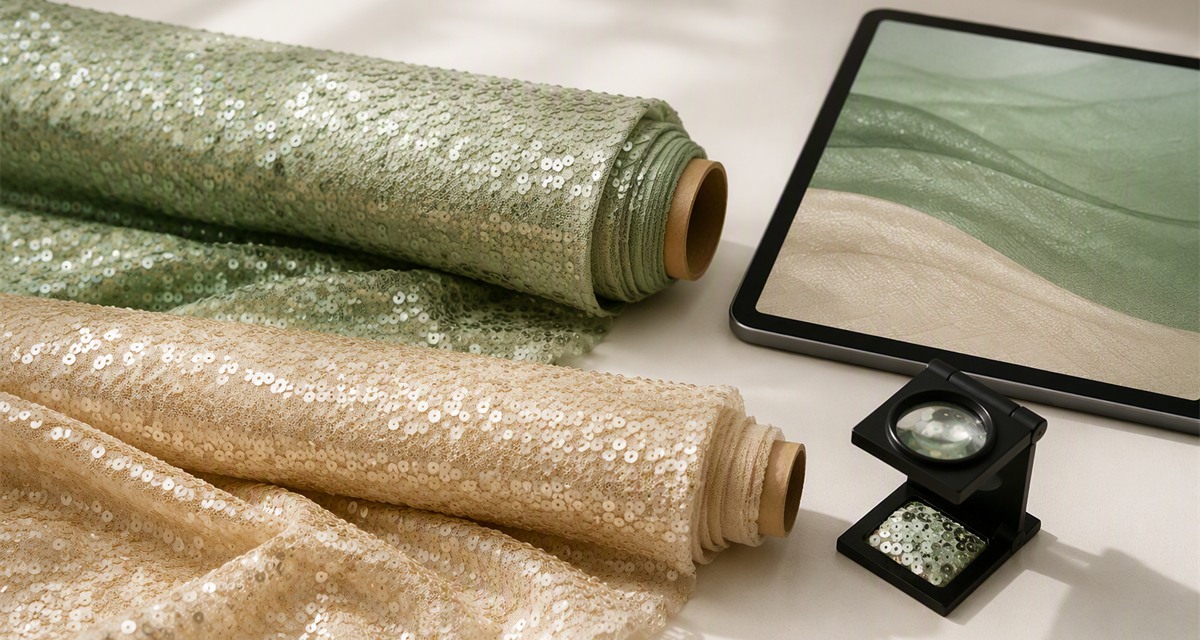
Technical Specifications and Material Tolerance Matrix
When selecting the ideal custom sequin fabric wholesale material for specific garment silhouettes, review this technical performance matrix:
| Technical Parameter | Standard PET Mesh Sequin | 4-Way Stretch Spandex Sequin | Heavyweight Reversible Sequin |
|---|---|---|---|
| Base Composition | 100% Polyester Tulle | 88% Nylon, 12% Spandex | 100% Polyester Tricot Mesh |
| Sequin Material | 100% PET Virgin Film | 100% High-Grade PET | Dual-Color Reversible PET |
| Sequin Diameters Available | 3mm, 5mm, 7mm | 3mm, 5mm Micro-Paillette | 5mm Reversible Dual-Sided |
| Total Weight (GSM) | 180 – 260 GSM (±5%) | 240 – 340 GSM (±5%) | 380 – 520 GSM (±5%) |
| Total / Usable Width | 150 cm / 130 cm | 150 cm / 135 cm | 145 cm / 125 cm |
| Dimensional Stability | Elongation < 5% | 4-Way Stretch (100% Recovery) | Elongation < 8% |
| Heat Tolerance | Up to 150°C (302°F) | Up to 140°C (284°F) | Up to 150°C (302°F) |
| Recommended Applications | Evening gowns, cocktail wear | Catsuits, dancewear, leggings | Reversible graphics, outerwear |
| Standard B2B MOQ | 200 Yards / Custom Color | 200 Yards / Custom Color | 200 Yards / Custom Color |
Quality Control in Custom Sequin Fabric Wholesale Production
To ensure consistent quality, quality assurance teams rely on standardized test methods during laboratory screening and factory acceptance audits:
| Inspection Dimension | Testing / Evaluation Method | Tolerance / Acceptable Quality Level | Actionable Failure Criteria |
|---|---|---|---|
| Sequin Anchorage | ASTM D3939 / Tape Pull Test | Zero detachment on 3M 810 tape lift | > 2 loose sequins per square yard |
| Colorfastness to Washing | AATCC 61 (2A Test) / ISO 105-C06 | Grade 4.0 or higher (Gray Scale) | Color bleeding onto base mesh or lining |
| Colorfastness to Rubbing | AATCC 8 / ISO 105-X12 (Crocking) | Dry Crocking: Grade 4.5 / Wet: Grade 4.0 | Visible metallic layer peeling under friction |
| Usable Width Verification | Calibrated Steel Tape Measurement | Minimum 130 cm clear embroidery area | Unstitched border exceeding 10 cm per side |
| Weight Consistency (GSM) | Circular GSM Cutter & Digital Balance | ±5% across 5 test points per roll | Deviation exceeding ±8% from target GSM |
| Bow and Skew Tolerance | ASTM D3882 Bow / Skew Protocol | Max 2.0% angular distortion | Noticeable curve in geometric sequin lines |
| Needle Breakage & Snags | Metal Detector & Visual Scan | 100% Metal Detection Pass | Any embedded broken needle fragment |
Frequently Asked Questions (FAQ)
What is the minimum order quantity (MOQ) for custom sequin fabric wholesale?
Our unified factory minimum order quantity is 200 yards per custom color, pattern, or base mesh substrate. As a result, this flexible threshold allows fashion designers and retail brands to develop seasonal capsule lines without excessive inventory commitment.
Can custom sequin patterns and Pantone colors be developed from physical swatches?
Yes, absolutely. Our engineering department in Ruzhou, Henan provides computerized color-matching and CAD embroidery digitizing. In addition, physical strike-offs are delivered within 3 to 5 business days upon receiving your target Pantone code or original artwork swatches for custom custom decorative fabrics.
How does Yunfan Textile prevent sequin shedding during pattern cutting?
Our facility operates multi-head computerized lock-stitch embroidery machinery using high-tenacity core-spun polyester thread. Furthermore, automated back-tack stitching locks every sequin row at both lateral margins, ensuring that shears cutting along pattern lines do not trigger sequential unraveling.
What physical testing standards are applied to export-ready sequin rolls?
All finished fabric bolts undergo standardized laboratory verification based on recognized international criteria. Specifically, technicians apply AATCC 61 and ISO 105 for colorfastness, ASTM D5430 for 4-point visual defect grading, and ASTM D3939 for surface snag resistance.
Conclusion
In conclusion, building a competitive fashion collection requires a dependable supply of custom sequin fabric wholesale textiles. By partnering directly with an experienced manufacturing facility that emphasizes precision lock-stitching, virgin PET materials, and rigorous 4-point inspection standards, apparel brands achieve consistent quality and reduce costly cutting-room defects. Yunfan Textile provides agile B2B production, transparent quality assurance, and dedicated overseas support to streamline your fabric sourcing journey.
Direct B2B Sourcing on Alibaba
Explore our full catalogue of custom sequin fabrics, order verified production samples, and trade with Trade Assurance on our official Alibaba store.
View Yunfan Textile on Alibaba →Request Fabric Samples & Custom Sourcing Consultation
Request sequin fabric samples and share your target GSM, width, sequin size, and colour reference.
Talk to Morris directly:
- 📧 Email: morris@yunfantextile.com
- 💬 WhatsApp 1: +86 156 3752 5803
- 💬 WhatsApp 2: +86 175 1619 6727