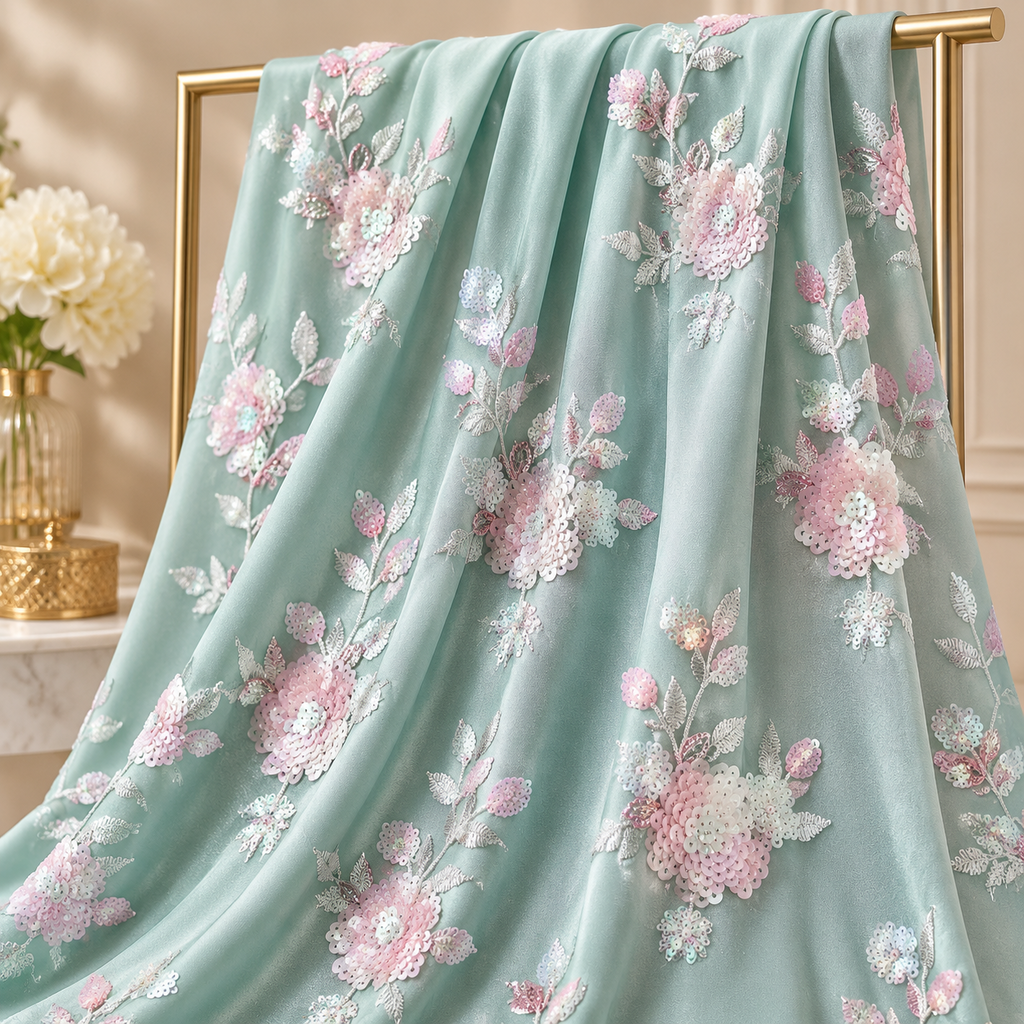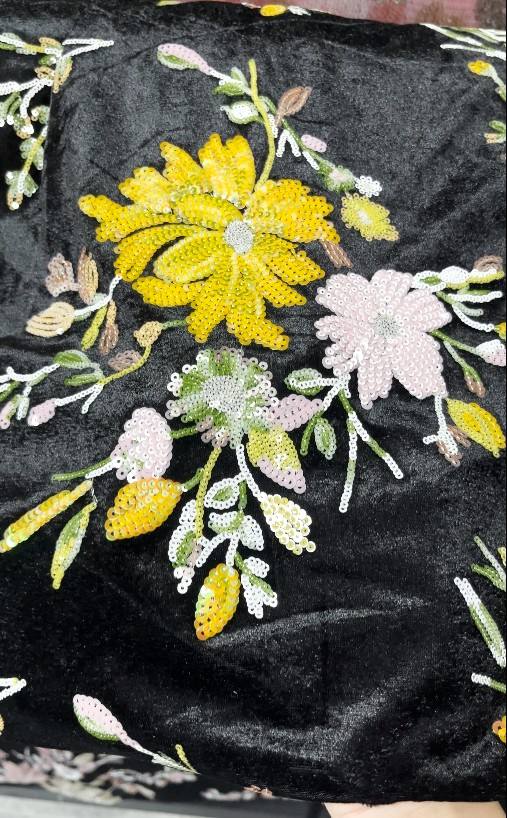
corded lace dye metamerism is a production control question for buyers who need repeatable decorative fabric performance. This guide connects material science, machine settings, factory testing, and shipment approval. It is written for apparel brands, costume teams, sourcing managers, and quality inspectors who need clear evidence before a bulk order. The recommended minimum order is 200 yards.
What Is corded lace dye metamerism?
Corded lace dye metamerism is a lighting-dependent colour shift that occurs when rayon cords, polyester mesh, and glass beads reflect different spectral energy. In practical terms, the failure appears when a decorative surface and its support fabric respond at different rates to a machine force, heat cycle, liquid, or light source. Therefore, a supplier must control the construction, process window, and inspection method together. A single attractive strike-off cannot prove bulk consistency.
For B2B approval, the team should define the fabric width, usable width, GSM, base composition, decoration density, colour reference, and tolerance before sampling. Then, the mill should record lot numbers and retain a signed standard. This sequence gives purchasing and production teams one shared reference when they compare lab results, pilot garments, and packed rolls.
Why corded lace dye metamerism Matters in Bulk Production
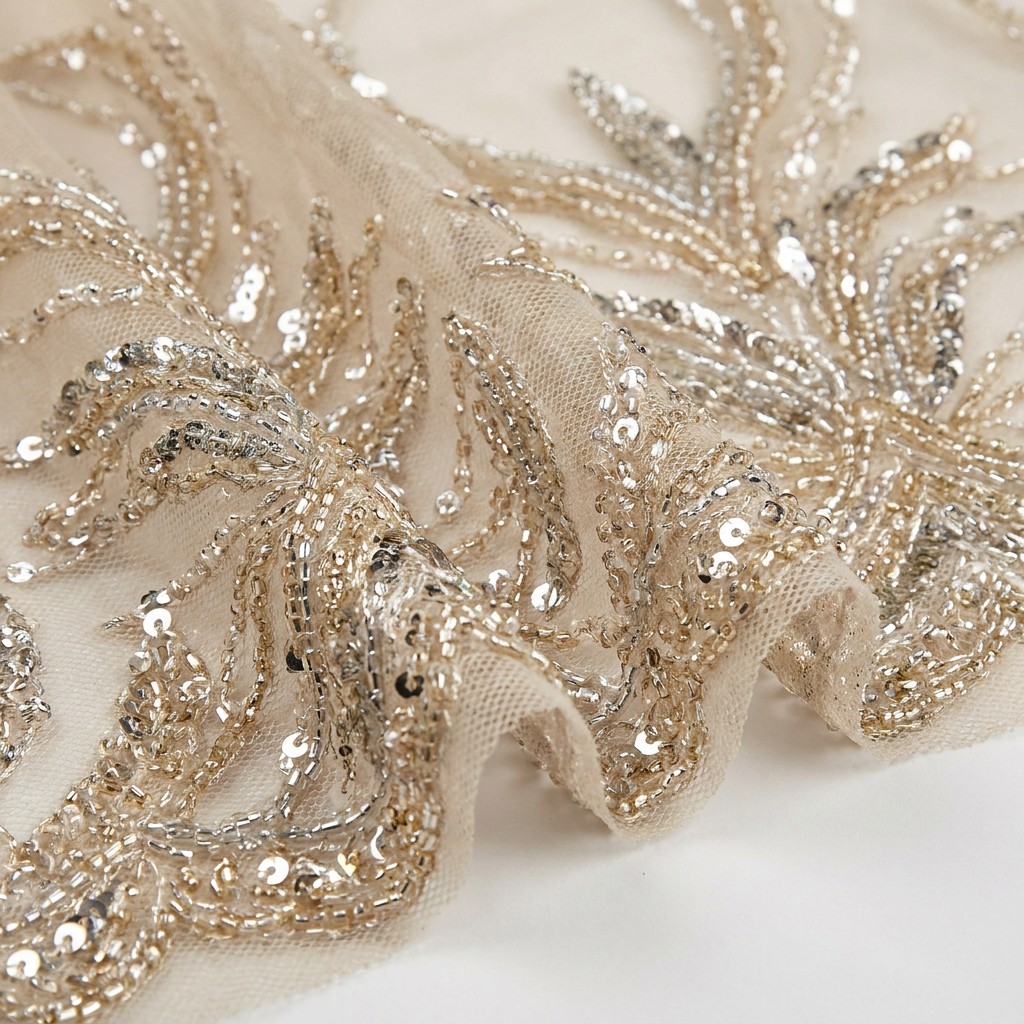
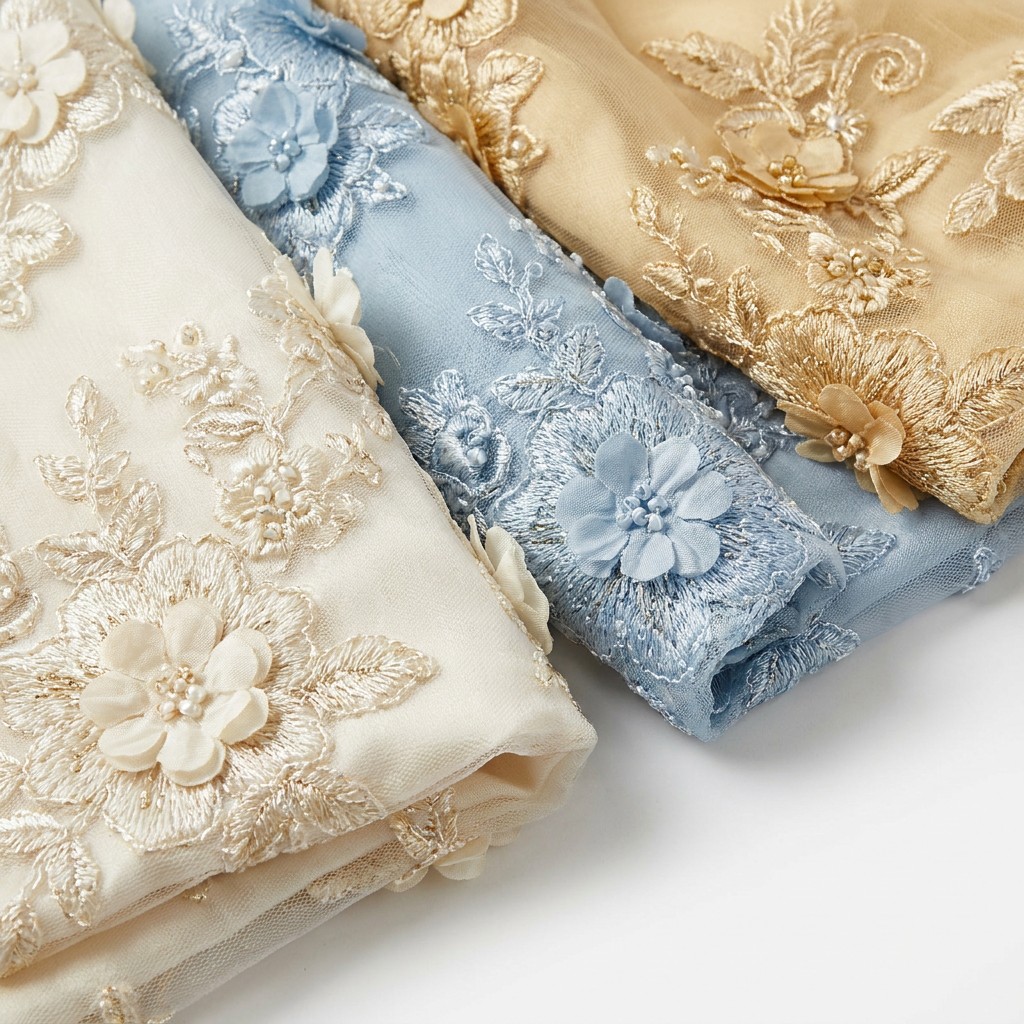
A corded lace construction contains materials with different surfaces and optical histories. Rayon cords absorb dye in a fibre-rich structure. Polyester mesh reflects more light from a synthetic surface. Glass tube beads add sharp highlights and partial transmission. Under one lamp these components can look coordinated, yet the balance can change when the retail lighting spectrum changes.
D65 represents a daylight reference, while TL84 and CWF approximate common commercial fluorescent environments. The eye does not judge one average colour only. It notices the relationship between cord, ground, bead, and garment lining. Therefore, a lab dip can pass under a single light and still create a visible jump on a store floor.
ASTM D1729 multi-source evaluation should use a calibrated viewing cabinet and controlled surrounding conditions. Place the signed standard beside the lab dip, align the nap and bead direction, and evaluate D65, TL84, and CWF in a fixed sequence. Allow the observer to rest between sources. Record the light source, observer, specimen position, and decision.
Instrumental evidence adds value when it is linked to the visual decision. Compare spectral reflectance curves for rayon cord and polyester mesh, not only one Delta E number. A curve crossing can explain why two samples match under daylight but separate under fluorescent light. The lab should retain the curve, software setting, aperture, and calibration record.
Use CMC 2:1 Delta E below 0.8 as a disciplined internal target for the agreed component comparison. The number is not a substitute for a visual review because beads can create directional sparkle and local highlights. Define whether the tolerance applies to the cord, mesh, assembled lace, or a complete lined garment panel.
Lab-dip approval should include a physical signed swatch, a light-box report, dye formula reference, substrate lot, bead lot, and finish. The dye house should not change rayon supplier, polyester heat history, or softener without a new approval. Small chemistry changes can shift absorption, gloss, or fluorescence even when the nominal colour recipe stays unchanged.
During bulk inspection, compare rolls under the approved cabinet and under a neutral daylight source. Inspect left, centre, and right areas because cord coverage can vary across the width. Also review the lace on the intended lining. A transparent mesh may look balanced alone but appear warmer or cooler when the lining changes.
When a mismatch appears, isolate the component causing the shift before requesting a full re-dye. Re-dyeing a cord may damage strength or hand. Changing the lining may solve the visual relationship with less risk. The corrective-action report should state the cause, the selected remedy, the retest result, and the lot disposition.
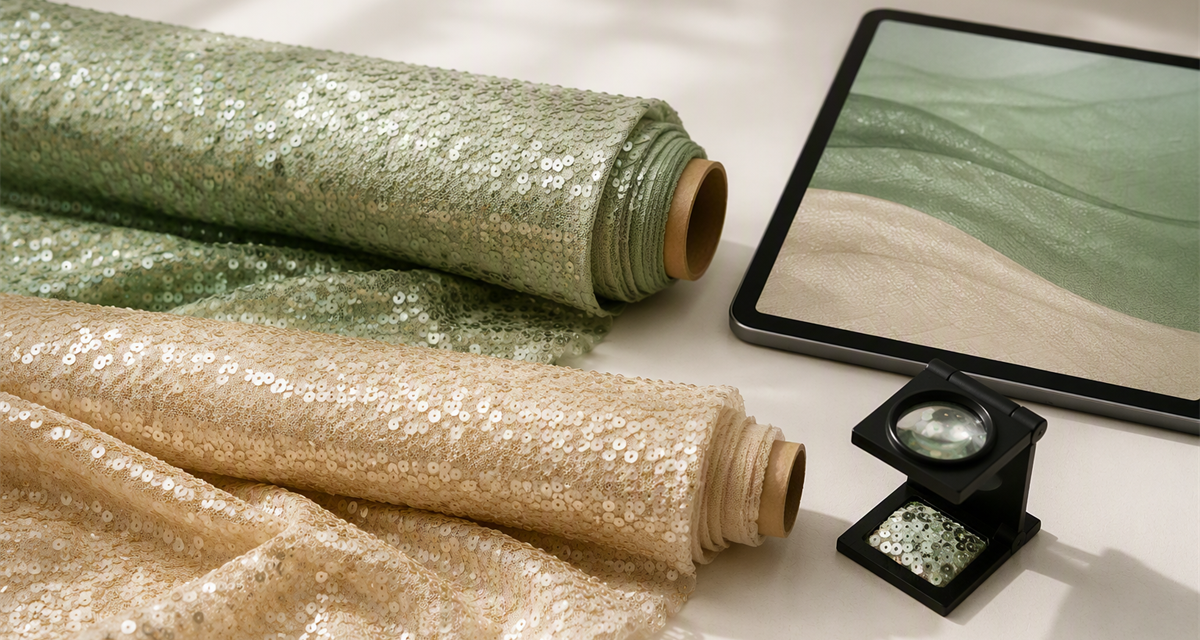
Industrial Test Method and Acceptance Window
A robust test plan starts with conditioning. Condition specimens for at least 24 hours at the agreed laboratory climate, cut from the left, centre, and right of the roll, and label every direction. Test both the decoration and the base because the visible fault often begins in the hidden layer. Use the named method in the purchase specification, record the instrument, operator, date, and lot, and photograph any failure before rework.
| Control point | Method or setting | B2B acceptance target | Evidence |
|---|---|---|---|
| Viewing source | ASTM D1729 cabinet: D65, TL84, CWF | No unacceptable component jump | Signed multi-light report |
| Instrument reading | Spectral reflectance curve comparison | CMC 2:1 Delta E < 0.8 target | Calibration and curve file |
| Lab dip | Rayon cord, polyester mesh, glass bead assembly | Signed standard matched in all sources | Approved swatch and formula |
| Bulk audit | Three width positions and intended lining | No visible lot shift | Roll-level inspection log |
The control limit should be practical rather than cosmetic. A buyer can approve a narrow technical tolerance when the supplier proves that the tolerance predicts garment performance. Conversely, a perfect laboratory result has little value if operators change needle type, press temperature, thread, detergent, or lighting during production. Freeze the approved recipe and audit the first, middle, and last rolls.
Factory Quality-Control Checklist
| Stage | Inspector action | Release rule |
|---|---|---|
| Pre-production | Confirm signed lab dip, construction sheet, MOQ 200 yards, and approved trim or thread. | No open specification or unapproved substitute. |
| Pilot run | Inspect three fabric zones and run a representative seam, press, wash, rub, or tension trial. | All critical defects remain within the agreed tolerance. |
| Bulk running | Check machine settings, lot identity, roll edges, surface appearance, and test frequency. | Quarantine any roll with a trend toward the limit. |
| Final audit | Use a four-point appearance review and attach test records to the packing list. | Release only traceable, dry, protected rolls. |
For every nonconformity, record the defect code, location, affected metres, probable cause, containment action, and preventive action. A good corrective report links the defect to a controllable variable. Examples include stitch density, tension, dwell time, bath pH, coating cure, or an incorrect material lot. This approach prevents a visual repair from hiding a repeatable process risk.
Key Takeaways for Sourcing Teams
First, approve a measurable construction and a signed visual standard. Second, test specimens from multiple roll positions rather than one convenient swatch. Third, connect the laboratory limit to the actual garment operation. Finally, retain traceability from sample to bulk shipment. With these controls, Yunfan Textile can review target GSM, width, colour, decoration density, and production schedule before confirming a 200 yards order.
FAQ: What should a buyer send for sampling?
Send the target end use, base composition, finished width, GSM range, colour reference, decoration scale, and expected finishing route. Also send a physical standard when colour or handle matters. Morris can then match the technical brief to a controlled sample and explain the test evidence before bulk production.
FAQ: How should a team approve a borderline result?
Do not approve a borderline result by email alone. Repeat the test with a retained specimen, compare the result with the signed standard, and review the risk in the intended garment process. If the result remains outside the limit, ask for a documented corrective action and a new sample. This protects delivery timing and reduces claims.
FAQ: What information supports a fast quotation?
Share the focus application, quantity, target width, GSM, colour, finish, packing preference, destination, and deadline. A complete brief avoids avoidable sample cycles. The minimum order for this programme is 200 yards, while final pricing depends on construction, decoration, testing, and packing requirements.
Read the Quality Control category for inspection planning and the Embroidery Fabric category for related decorative constructions. These resources help product teams compare process evidence, not only photographs.
Source direct on Alibaba - request bulk pricing, specifications, and production details in one place.
corded lace dye metamerism is a production control question for buyers who need repeatable decorative fabric performance. This guide connects material science, machine settings, factory testing, and shipment approval. It is written for apparel brands, costume teams, sourcing managers, and quality inspectors who need clear evidence before a bulk order. The recommended minimum order is 200 yards.
What Is corded lace dye metamerism?
Corded lace dye metamerism is a lighting-dependent colour shift that occurs when rayon cords, polyester mesh, and glass beads reflect different spectral energy. In practical terms, the failure appears when a decorative surface and its support fabric respond at different rates to a machine force, heat cycle, liquid, or light source. Therefore, a supplier must control the construction, process window, and inspection method together. A single attractive strike-off cannot prove bulk consistency.
For B2B approval, the team should define the fabric width, usable width, GSM, base composition, decoration density, colour reference, and tolerance before sampling. Then, the mill should record lot numbers and retain a signed standard. This sequence gives purchasing and production teams one shared reference when they compare lab results, pilot garments, and packed rolls.
Why corded lace dye metamerism Matters in Bulk Production
A corded lace construction contains materials with different surfaces and optical histories. Rayon cords absorb dye in a fibre-rich structure. Polyester mesh reflects more light from a synthetic surface. Glass tube beads add sharp highlights and partial transmission. Under one lamp these components can look coordinated, yet the balance can change when the retail lighting spectrum changes.
D65 represents a daylight reference, while TL84 and CWF approximate common commercial fluorescent environments. The eye does not judge one average colour only. It notices the relationship between cord, ground, bead, and garment lining. Therefore, a lab dip can pass under a single light and still create a visible jump on a store floor.
ASTM D1729 multi-source evaluation should use a calibrated viewing cabinet and controlled surrounding conditions. Place the signed standard beside the lab dip, align the nap and bead direction, and evaluate D65, TL84, and CWF in a fixed sequence. Allow the observer to rest between sources. Record the light source, observer, specimen position, and decision.
Instrumental evidence adds value when it is linked to the visual decision. Compare spectral reflectance curves for rayon cord and polyester mesh, not only one Delta E number. A curve crossing can explain why two samples match under daylight but separate under fluorescent light. The lab should retain the curve, software setting, aperture, and calibration record.
Use CMC 2:1 Delta E below 0.8 as a disciplined internal target for the agreed component comparison. The number is not a substitute for a visual review because beads can create directional sparkle and local highlights. Define whether the tolerance applies to the cord, mesh, assembled lace, or a complete lined garment panel.
Lab-dip approval should include a physical signed swatch, a light-box report, dye formula reference, substrate lot, bead lot, and finish. The dye house should not change rayon supplier, polyester heat history, or softener without a new approval. Small chemistry changes can shift absorption, gloss, or fluorescence even when the nominal colour recipe stays unchanged.
During bulk inspection, compare rolls under the approved cabinet and under a neutral daylight source. Inspect left, centre, and right areas because cord coverage can vary across the width. Also review the lace on the intended lining. A transparent mesh may look balanced alone but appear warmer or cooler when the lining changes.
When a mismatch appears, isolate the component causing the shift before requesting a full re-dye. Re-dyeing a cord may damage strength or hand. Changing the lining may solve the visual relationship with less risk. The corrective-action report should state the cause, the selected remedy, the retest result, and the lot disposition.
Industrial Test Method and Acceptance Window
A robust test plan starts with conditioning. Condition specimens for at least 24 hours at the agreed laboratory climate, cut from the left, centre, and right of the roll, and label every direction. Test both the decoration and the base because the visible fault often begins in the hidden layer. Use the named method in the purchase specification, record the instrument, operator, date, and lot, and photograph any failure before rework.
| Control point | Method or setting | B2B acceptance target | Evidence |
|---|---|---|---|
| Viewing source | ASTM D1729 cabinet: D65, TL84, CWF | No unacceptable component jump | Signed multi-light report |
| Instrument reading | Spectral reflectance curve comparison | CMC 2:1 Delta E < 0.8 target | Calibration and curve file |
| Lab dip | Rayon cord, polyester mesh, glass bead assembly | Signed standard matched in all sources | Approved swatch and formula |
| Bulk audit | Three width positions and intended lining | No visible lot shift | Roll-level inspection log |
The control limit should be practical rather than cosmetic. A buyer can approve a narrow technical tolerance when the supplier proves that the tolerance predicts garment performance. Conversely, a perfect laboratory result has little value if operators change needle type, press temperature, thread, detergent, or lighting during production. Freeze the approved recipe and audit the first, middle, and last rolls.
Factory Quality-Control Checklist
| Stage | Inspector action | Release rule |
|---|---|---|
| Pre-production | Confirm signed lab dip, construction sheet, MOQ 200 yards, and approved trim or thread. | No open specification or unapproved substitute. |
| Pilot run | Inspect three fabric zones and run a representative seam, press, wash, rub, or tension trial. | All critical defects remain within the agreed tolerance. |
| Bulk running | Check machine settings, lot identity, roll edges, surface appearance, and test frequency. | Quarantine any roll with a trend toward the limit. |
| Final audit | Use a four-point appearance review and attach test records to the packing list. | Release only traceable, dry, protected rolls. |
For every nonconformity, record the defect code, location, affected metres, probable cause, containment action, and preventive action. A good corrective report links the defect to a controllable variable. Examples include stitch density, tension, dwell time, bath pH, coating cure, or an incorrect material lot. This approach prevents a visual repair from hiding a repeatable process risk.
Key Takeaways for Sourcing Teams
First, approve a measurable construction and a signed visual standard. Second, test specimens from multiple roll positions rather than one convenient swatch. Third, connect the laboratory limit to the actual garment operation. Finally, retain traceability from sample to bulk shipment. With these controls, Yunfan Textile can review target GSM, width, colour, decoration density, and production schedule before confirming a 200 yards order.
FAQ: What should a buyer send for sampling?
Send the target end use, base composition, finished width, GSM range, colour reference, decoration scale, and expected finishing route. Also send a physical standard when colour or handle matters. Morris can then match the technical brief to a controlled sample and explain the test evidence before bulk production.
FAQ: How should a team approve a borderline result?
Do not approve a borderline result by email alone. Repeat the test with a retained specimen, compare the result with the signed standard, and review the risk in the intended garment process. If the result remains outside the limit, ask for a documented corrective action and a new sample. This protects delivery timing and reduces claims.
FAQ: What information supports a fast quotation?
Share the focus application, quantity, target width, GSM, colour, finish, packing preference, destination, and deadline. A complete brief avoids avoidable sample cycles. The minimum order for this programme is 200 yards, while final pricing depends on construction, decoration, testing, and packing requirements.
Read the Quality Control category for inspection planning and the Embroidery Fabric category for related decorative constructions. These resources help product teams compare process evidence, not only photographs.
Request Sequin Fabric Samples and share your target GSM, width, sequin size, and colour reference.
Talk to Morris directly:
Email: morris@yunfantextile.com
WhatsApp: +86 156 3752 5803
WhatsApp: +86 175 1619 6727