beaded fabric weight distribution for dependable B2B sourcing
beaded fabric weight distribution matters when a decorative fabric must look consistent, sew cleanly, and arrive ready for production. This guide explains the physical cause, factory controls, and inspection evidence that buyers can request from a specialist mill.
First, define the risk in measurable terms. Then connect the risk to a process setting and a release test. This gives designers, merchandisers, and quality teams one practical language for approval.
Why heavy beadwork changes behaviour
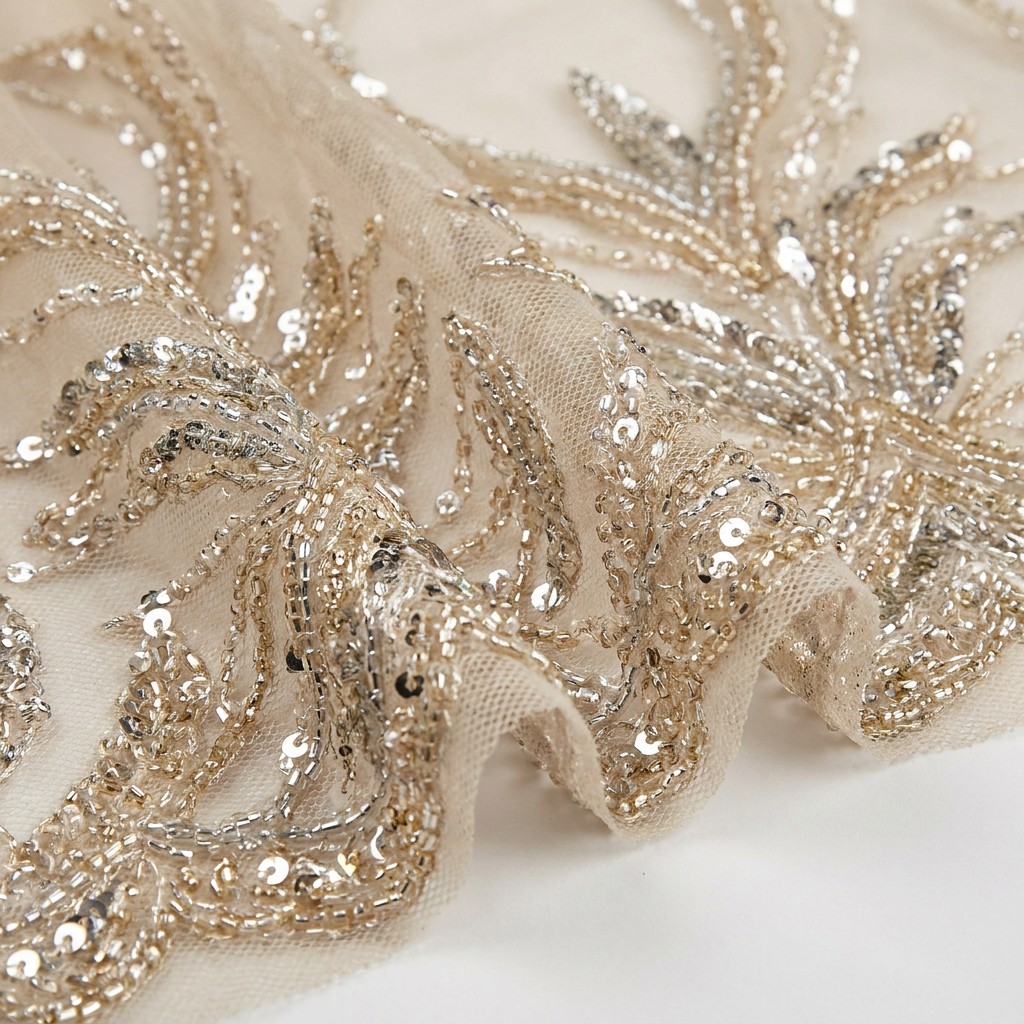
Heavy beaded embroidery fabric can reach 300–600 GSM or more. Gravity creates a different load when the panel hangs. Beads pull along the warp direction, while embroidery bridges transfer weight to limited stitch zones.
If weight is uneven, one side of a garment drops faster than the other. The result appears as a tilted hem, distorted neckline, or open seam. Measure distribution before pattern cutting.
Mapping beaded fabric weight distribution
Map GSM at the centre, edges, motif border, and blank areas. Compare left and right halves, then record the heaviest repeat. A grid reveals whether dense motifs create local loading.
Use the same relaxed conditioning time for every measurement. Do not stretch the mesh while weighing it. The report should state sample size, balance resolution, location, and tolerance.
Base-mesh reinforcement and load paths
A stronger base mesh distributes force across more yarns. A narrow reinforcement strip under a neckline or side seam can create a load path without supporting the whole panel.
For dense motifs, use backing during embroidery. The backing should prevent stitch distortion while remaining removable or comfortable. Test the complete stack because bead, thread, mesh, and backing work together.
Warp support and load-bearing bars
Warp-direction support bars can be woven or placed in areas that carry a hanger or seam. Their spacing should match the motif repeat and expected garment load.
Ask for a diagram showing bar location, width, yarn type, and connection to the selvedge. Verify that bars do not create visible lines through the face.
Seam slippage testing
ASTM D434 and ISO 13936 provide useful references for seam slippage evaluation. Test a representative seam with actual allowance, thread, stitch density, and mesh.
Record opening, yarn displacement, bead interference, and stitch breakage. Test warp and weft because gravity and pattern geometry load them differently.
Hanger sag prevention
A hanger supports a small area, so the load path must reach stable structure. Use an appropriate hanger width, internal stay tape, and temporary support during storage.
Check the item after a timed hanging trial. Measure shoulder drop, hem change, and seam opening before and after. Flat tensile performance alone cannot predict display behaviour.
Balanced pattern placement
Keep dense motifs inside reinforced garment zones. Balance left and right panels and avoid the heaviest repeat at a free edge. Mark warp direction on every roll.
A cutting plan includes nap, motif repeat, bead direction, and reinforcement placement. Avoid crushing beads under a conventional spreading roll.
Storage and transport packaging
Wind heavy embroidered material onto a firm core with controlled tension. Use separators between delicate faces and support the roll so the edge cannot collapse.
Use moisture protection that does not trap condensation. Include corner protection, lot labels, and packing photographs. Let rolls relax before incoming inspection.
How B2B buyers set a repeatable specification
Start with a signed reference swatch, a technical data sheet, and a tolerance table. Record composition, usable width, GSM, construction, finish, colour code, roll length, and packing method. A clear specification lets production, inspection, and receiving teams measure the same result.
Next, approve a lab dip, strike-off, or development panel before bulk cutting. Keep one sealed approval sample with the purchase order. Then request an inline report, a final inspection report, and photographs of packed rolls. This sequence reduces disputes because every checkpoint has an owner and an acceptance rule.
MOQ, sampling, and production planning
Yunfan Textile supports a practical MOQ of 200 yards for these decorative fabric programs. Buyers can combine a confirmed colour, width, and construction with a realistic production window. Morris can advise on sample yardage, repeat placement, and the safest packing format for international delivery.
For a new design, reserve time for a first sample, a corrected sample when needed, and a pre-production approval. Allow extra time when the order includes special yarns, metallic effects, complex embroidery, or a custom finish. Clear approvals protect the buyer launch calendar and the factory production stability.
Inspection records that support confident sourcing
A useful B2B inspection sheet shows lot number, roll number, measured result, instrument, test method, inspector, and disposition. It also shows how defects are classified. Critical defects require rejection, major defects require a corrective action, and minor defects require a documented acceptance decision.
Ask the supplier to retain counter-samples from every approved lot. In addition, request images under consistent lighting and a short video of the material in motion. These records make remote approval more reliable and help your team compare future shipments with the original benchmark.
Sampling and communication checklist
- Confirm fibre content, width, GSM, usable area, and construction.
- State the colour reference, surface effect, backing, and intended end use.
- Define inspection method, tolerance, packing label, and roll identification.
- Approve a physical sample before the factory starts bulk production.
- Share delivery terms and contact Morris for a coordinated production plan.
For broader sourcing guidance, review the Quality Control category and the Sequin Fabric category. These internal resources help teams compare specifications, testing, and production controls before placing a purchase order.
Frequently asked questions for importers
Can I request a development sample? Yes. Share the target construction and end use with Morris so the team can confirm the most efficient sample route before the 200-yard production MOQ.
How should I approve colour? Approve a physical swatch under agreed lighting, record the reference number, and keep a signed control sample. A screen image alone cannot define a decorative surface accurately.
What should arrive with a bulk shipment? Request the packing list, roll map, final inspection report, relevant test results, and photographs showing labels and outer packaging.
Request a controlled development plan for beaded fabric weight distribution
Share your target application, construction, colour reference, width, and delivery window. Morris will help match the sample to the production route, explain the measurable tolerance, and confirm the 200-yard MOQ. A written approval protects your team from avoidable variation.
Source direct on Alibaba - request bulk pricing, specifications, and production details in one place.
View Yunfan Textile on AlibabaRequest Sequin Fabric Samples and share your target GSM, width, sequin size, and colour reference.
Talk to Morris directly:
Email: morris@yunfantextile.com
WhatsApp: +86 156 3752 5803
WhatsApp: +86 175 1619 6727

Implementation notes for a reliable decorative fabric program
Production teams benefit from a short control plan that connects the design brief to measurable factory actions. Begin with a physical reference, then list every variable that can change the result. These variables may include fibre, yarn, backing, coating, stitch density, machine speed, humidity, heat, storage time, and packing pressure. Assign each variable to a process owner and define the evidence required at approval.
Before bulk work starts, the factory should make a representative pilot panel. The pilot should include the most demanding motif, the most delicate edge, and the heaviest or densest area. Inspect the panel after conditioning and after the intended finishing operation. If the panel passes, keep it as a control sample. If it fails, record the failure mode and change only one process variable at a time.
Remote B2B approval works best when the photos, videos, and test reports use repeatable conditions. Use the same light source, camera distance, background, specimen direction, and scale. Show both the face and reverse. For dimensional checks, measure relaxed material rather than a piece held under tension. This discipline makes a supplier report useful to a product developer who is working in another time zone.
Buyers should also separate appearance acceptance from performance acceptance. A fabric can look correct but fail recovery, abrasion, seam stability, or packing simulation. Conversely, a technically strong fabric may need a small appearance adjustment before it suits a collection. Use a signed approval table with a clear disposition: accepted, accepted with note, rework required, or rejected.
After shipment, open a representative roll before releasing the whole order to cutting. Check label data, width, surface, hand, construction, and the most relevant test result. Record any difference from the control sample immediately. Early feedback allows the supplier to investigate the same lot and prevents a small issue from spreading across finished garments.
Finally, keep the control sample, inspection report, packing photographs, and corrective-action notes together with the purchase order. This file becomes a useful benchmark for repeat orders. It also helps both sides discuss facts instead of impressions. A consistent record supports faster quotations, more accurate production planning, and a more dependable customer delivery promise.