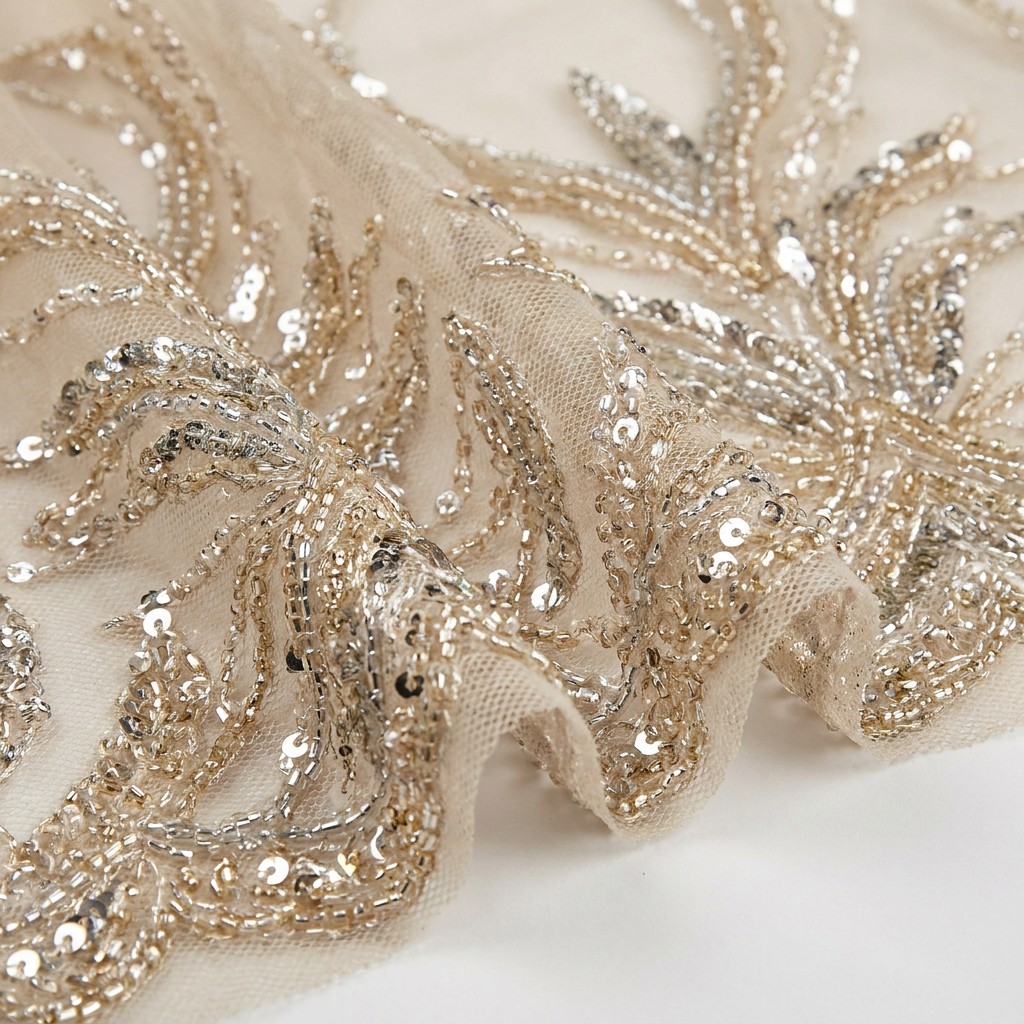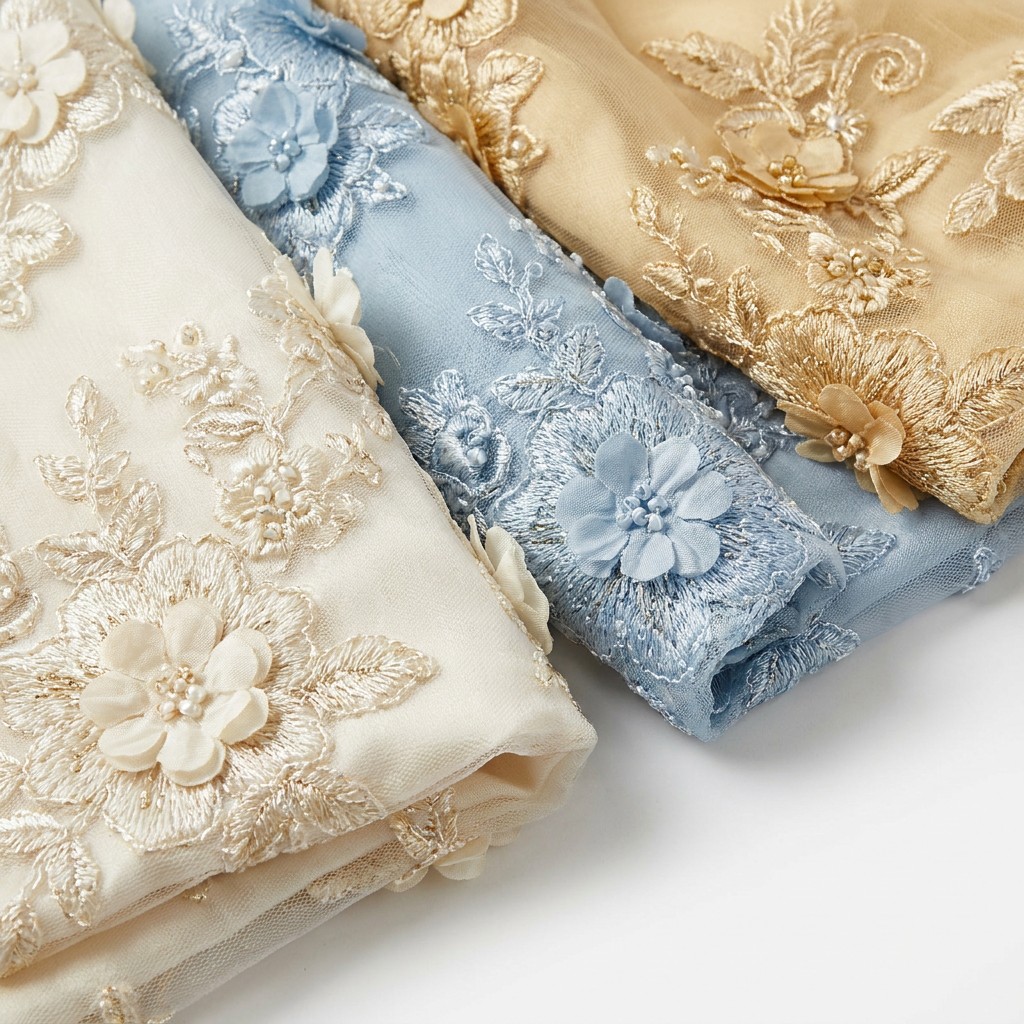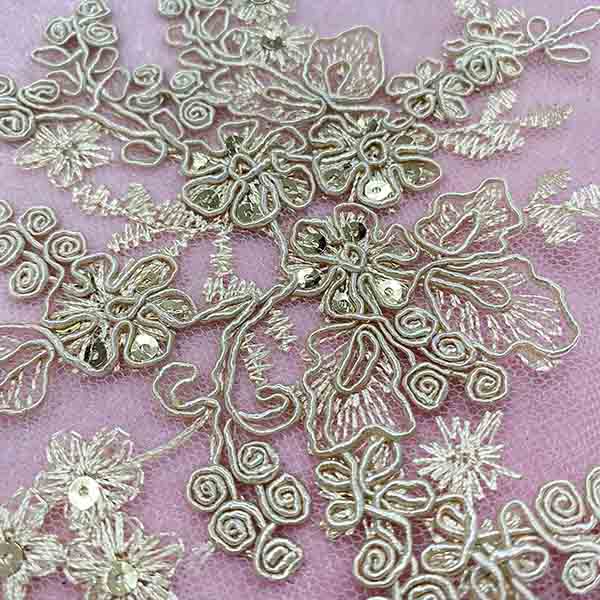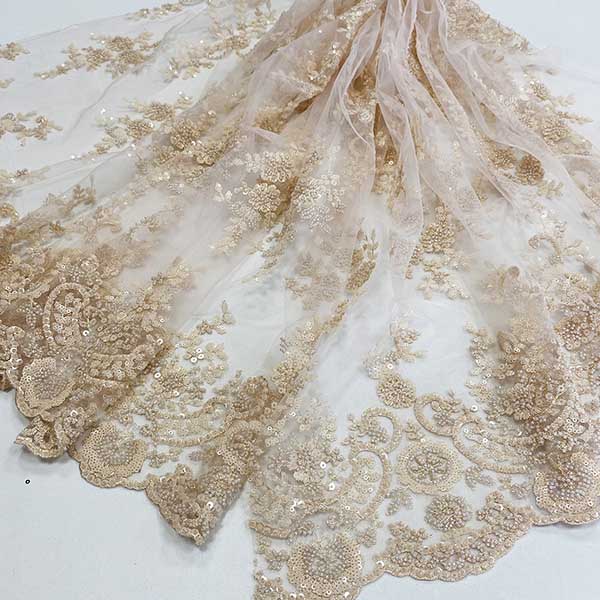
Sourcing high-end crystal beaded lace wholesale requires balancing faceted K9 crystal optical brilliance, heavy bead tensile anchoring, tulle mesh load resistance, and strict production tolerances. For luxury bridal ateliers, haute couture fashion houses, and red carpet gown manufacturers, procuring crystal-embellished lace textiles at scale introduces critical engineering challenges. For example, garment factories frequently encounter crystal claws snagging delicate chiffon overlays, mesh tearing under heavy bead weight along structural seamlines, and glass bead cracking under industrial sewing feet. Furthermore, traditional hand-embroidery workshops often impose excessive minimums and erratic lead times that disrupt seasonal runway schedules. Therefore, partnering directly with an integrated manufacturing facility resolves these challenges by providing transparent four-point quality control protocols, rapid laboratory strike-off sampling, and an accessible baseline factory MOQ of 200 yards per custom beaded motif.
Understanding Crystal Beaded Lace Wholesale Engineering: K9 Crystals, Seed Beads, and Structural Tulle
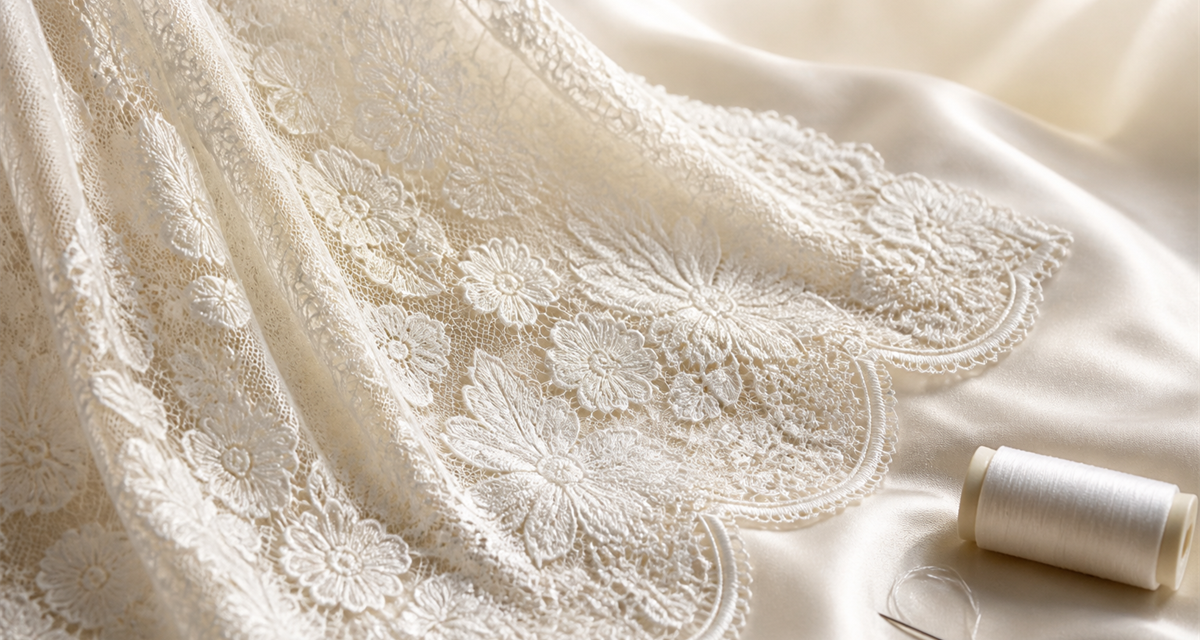
Crystal beaded lace is a prestigious ornamental textile where computerized embroidery machinery and skilled master artisans combine raised soutache embroidery with faceted glass crystals, glass bugle beads, and metallic seed beads. In commercial B2B garment engineering, optical refractive brilliance, tactile durability, and garment drape depend directly on the mechanical balance between three foundational components: the high-tensile base tulle, the precision-cut K9 crystal stones, and the high-tenacity monofilament locking thread.
1. Base Netting Substrates
Because heavy crystal embellishments apply substantial gravitational load, the underlying mesh must deliver exceptional tensile resistance without tearing:
- 100% High-Tenacity Polyester Hexagonal Mesh: The industry standard for heavy couture bridal gowns and evening capes (45–75 GSM). Consequently, this substrate provides superior load-bearing capacity, dimensional stability, and zero distortion under heavy crystal clusters.
- Reinforced Polyamide Bridal Tulle: Formulated with multi-filament nylon yarns (35–50 GSM). Specifically, this backing delivers soft hand feel, skin-contact comfort, and reliable tear resistance around dense crystal groupings.
- Organza and Silk-Touch Mesh Foundations: Semi-opaque backings (60–90 GSM) provide structural firmness and clean silhouette definition for tailored bridal bodices. You can explore our complete range of embroidery fabric collections across diverse base materials.
2. Crystal Stone Grades: Precision K9 Glass Chemistry
Selecting the appropriate crystal formulation directly prevents stone clouding, claw detachment, and thermal cracking during garment finishing:
- Faceted Optical K9 Glass Crystals: Mandatory for luxury couture apparel. Moreover, K9 crystal stones feature exceptional refractive clarity (refractive index > 1.51), lead-free environmental compliance, and endure continuous steam pressing up to 140°C (284°F).
- Acrylic and Plastic Rhinestones: Although acrylic rhinestones offer lower raw material weight, they scratch easily and develop cloudy surfaces under dry-cleaning solvents (perchloroethylene).
- Micro Seed Beads and Bugle Beads: Silver-lined glass seed beads and twisted bugle beads add multi-angled light diffraction around central crystal motifs.
3. Four-Prong Claw Setting and Lock-Stitch Tacking
- Brass Four-Prong Claw Settings: Heavy crystal stones sit in electroplated, nickel-free brass casings with folded mechanical prongs that permanently lock stone facets without sharp burs.
- High-Tenacity Nylon Monofilament Anchoring: Multi-pass lock-stitching anchors each claw casing and bead string with reinforced tie-off knots, preventing unraveling during pattern cutting.
Key Takeaways for B2B Crystal Beaded Lace Wholesale Buyers
- Mandate Optical K9 Glass over Acrylic: Always specify lead-free K9 glass crystals to guarantee maximum refractive brilliance, scratch resistance, and solvent stability during dry cleaning.
- Specify Prongs Smoothness and Nickel Compliance: Ensure brass claw casings undergo mechanical tumbling to eliminate sharp metal burs that could snag delicate companion lining fabrics.
- Require 5 cm Clear Unbeaded Seam Margins: Insist on clean 5 cm unembroidered salvage borders along both bolt margins to facilitate effortless seam joining without manual bead removal.
- Standardize Sample Validation and MOQ: Partner with flexible B2B suppliers offering a realistic 200-yard MOQ per custom beaded layout, supported by physical strike-off deliveries within 5 to 7 business days.
5-Step Crystal Beaded Lace Wholesale Sourcing Workflow
Procuring commercial-grade crystal beaded lace wholesale textiles requires precise technical alignment between couture design teams and mill engineers. Follow this five-stage manufacturing workflow to safeguard production timelines and product quality:
- Step 1: Technical Specification Submission
In the initial stage, buyers submit comprehensive design packs indicating base tulle composition, target GSM, usable width (e.g., 130 cm usable width on 145 cm overall width), crystal sizes (SS10, SS16, SS20), and standardized Pantone color references. - Step 2: Strike-Off Sampling & Claw Tension Prototyping
Next, our engineering team digitizes the beading layout and stitches a 1-yard production strike-off on actual multi-head machinery. Quality auditors inspect this swatch in standard D65 light booths to evaluate optical sparkle, hand feel, and claw security. - Step 3: Tension Calibration and Netting Pre-Setting
Before initiating bulk embroidery, technicians pre-set the base tulle under electronic tension frames to eliminate bowing. In addition, quality controllers test raw crystal claw tenacity according to strict B2B textile manufacturing standards. - Step 4: Inline 4-Point System Defect Grading
Throughout the embroidery run, automated optical sensors and experienced inspectors track missing beads, loose crystals, and tulle tears under ASTM D5430 standards. - Step 5: Bolt Finishing, Calendering, and Protective Packaging
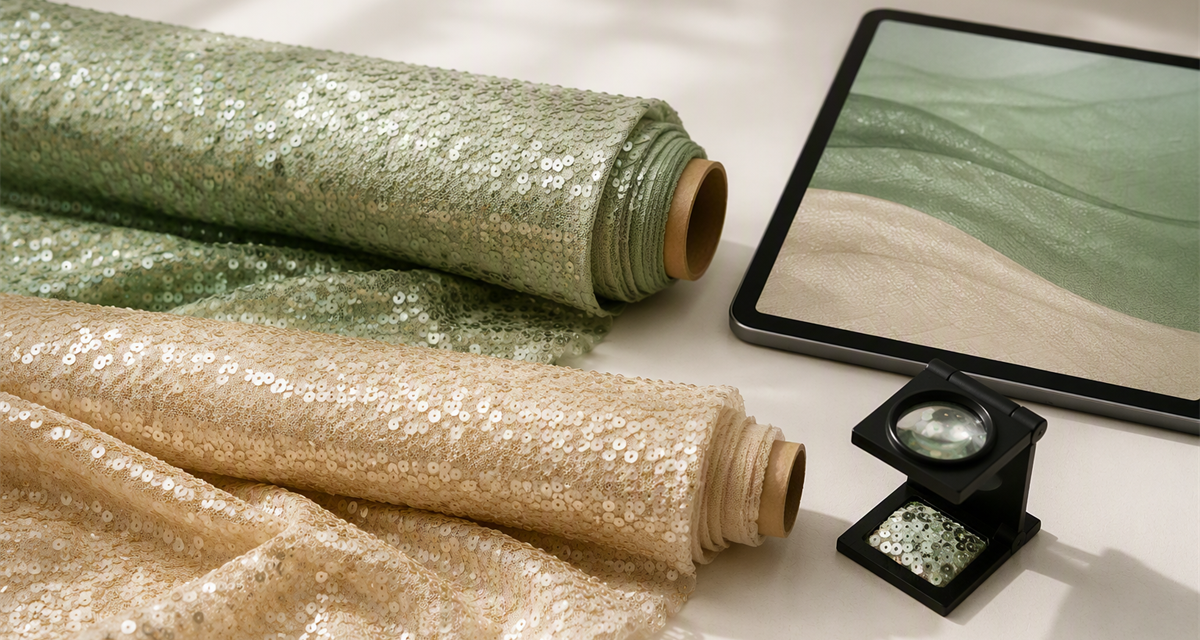
Finally, workers roll finished crystal beaded lace bolts onto rigid cardboard tubes, inserting protective foam interleaving to ensure heavy crystal stones do not crush or scratch during global maritime transit.
Technical Specifications and Material Tolerance Matrix
When selecting the ideal crystal beaded lace wholesale material for specific bridal and couture silhouettes, review this technical performance matrix:
| Technical Parameter | Bridal K9 Crystal Lace Tulle | Heavy Haute Couture Beaded Mesh | Crystal + Sequin Hybrid Lace |
|---|---|---|---|
| Base Composition | 100% Polyamide Reinforced Tulle | 100% High-Tenacity Polyester Mesh | 100% Polyester Hexagonal Mesh |
| Bead / Stone Types | Faceted K9 Crystals + Seed Beads | Claw Rhinestones + Bugle Beads | K9 Crystals + Virgin PET Sequins |
| Stone Casings | Four-Prong Nickel-Free Brass Claws | Electroplated Gold/Silver Claws | Flush-Mounted Bezel Casings |
| Total Weight (GSM) | 280 – 390 GSM (±5%) | 420 – 580 GSM (±5%) | 320 – 440 GSM (±5%) |
| Total / Usable Width | 145 cm / 130 cm | 140 cm / 125 cm | 148 cm / 130 cm |
| Dimensional Stability | Elongation < 2% | Elongation < 1.5% | Elongation < 2% |
| Heat Resistance | Up to 140°C (284°F) | Up to 145°C (293°F) | Up to 140°C (284°F) |
| Recommended Applications | Bridal gowns, luxury veil trims | Red carpet gowns, couture capes | Evening wear, gala dresses |
| Standard Factory MOQ | 200 Yards / Custom Color | 200 Yards / Custom Color | 200 Yards / Custom Color |
B2B Quality Control Checklist and Defect Tolerances
To guarantee zero-defect garment cutting, apparel quality managers apply standardized inspection criteria under our verified quality control testing standards:
| Inspection Dimension | Testing / Evaluation Protocol | Acceptable Quality Tolerance (AQL) | Failure Rejection Trigger |
|---|---|---|---|
| Crystal Stone Claw Retention | Digital Force Gauge Pull Test | > 20 N breaking force per crystal casing | Loose crystal stone rotating in claw |
| Tulle Mesh Tensile Load | ASTM D5034 Grab Tensile Test | > 95 N breaking load on base mesh | Mesh tearing under heavy bead clusters |
| Glass Bead Edge Smoothness | Optical Visual Scan & Felt Rub Test | Zero snagging on 100% silk lining felt | Sharp glass bugle edge cutting threads |
| Rubbing Colorfastness (Crocking) | AATCC 8 / ISO 105-X12 Crocking Test | Dry Crocking: Grade 4.5 / Wet: Grade 4.0 | Plating transfer from metal claw casings |
| Effective Usable Width | Calibrated Metric Steel Measure | Minimum 125 cm clear beaded area | Unstitched salvage border exceeding 10 cm |
| Weight Consistency (GSM) | Circular GSM Cutter & Digital Balance | ±5% across 5 test points per roll | Density variation exceeding ±8% |
| Needle Fragment Detection | Conveyor Metal Detection Protocol | 100% Metal Detection Pass | Any embedded metallic needle fragment |
Frequently Asked Questions (FAQ)
What is the minimum order quantity (MOQ) for custom crystal beaded lace wholesale?
Our unified factory minimum order quantity is strictly 200 yards per custom crystal motif layout, claw setting color, or specialized dye shade. Consequently, this accessible MOQ empowers luxury bridal ateliers and couture designers to develop exclusive red-carpet collections without excessive inventory commitments.
Can you develop custom crystal motifs and Pantone shades from physical swatches?
Yes, certainly. Our professional design studio in Ruzhou, Henan provides precision CAD stone placement digitizing and spectrophotometer color matching. In addition, physical strike-off swatches are delivered within 5 to 7 business days upon receiving your target Pantone code, sample swatch, or digital artwork for custom decorative fabrics.
How does Yunfan Textile prevent crystal claws from snagging companion lining fabrics?
Our factory implements brass four-prong claw casings that undergo automated rotary vibratory polishing before stone setting. Furthermore, by pressing prong tips flush against stone facets, our setting technique eliminates sharp metal edges that could snag silk chiffon linings.
What physical testing standards apply to export-ready crystal beaded lace?
All finished production bolts undergo rigorous laboratory verification based on recognized global standards. Specifically, technicians implement AATCC 8 for crocking fastness, ASTM D5034 for grab tensile strength, and ASTM D5430 for 4-point visual defect inspection.
Conclusion
In summary, securing a reliable supply of crystal beaded lace wholesale textiles requires partnering with an experienced manufacturing mill that masters precision K9 crystal claw setting, load-bearing tulle netting, and multi-pass lock-stitch anchoring. By defining clear technical criteria for claw pull strength, edge smoothness, and needle protection, fashion brands dramatically reduce cutting-room defects and deliver breathtaking red-carpet luxury. Yunfan Textile provides agile B2B production, rigorous four-point quality control, and dedicated customer support to power your creative couture collections.
Direct B2B Sourcing on Alibaba
Explore our full catalogue of custom crystal beaded and embroidered lace fabrics, order verified production samples, and trade with Trade Assurance on our official Alibaba store.
View Yunfan Textile on Alibaba →Request Fabric Samples & Custom Sourcing Consultation
Request crystal beaded lace samples and share your target GSM, width, stone size, and colour reference.
Talk to Morris directly:
- 📧 Email: morris@yunfantextile.com
- 💬 WhatsApp 1: +86 156 3752 5803
- 💬 WhatsApp 2: +86 175 1619 6727