Sourcing high-end beaded lace trim wholesale requires balancing intricate hand-guided glass bead anchoring, delicate scalloped border tensile strength, thread tension synchronization, and strict manufacturing tolerances. For couture bridal ateliers, luxury evening wear designers, and premium lingerie brands, purchasing beaded lace trims at volume introduces critical production hurdles. For example, garment factories frequently encounter bead detachment along curved neckline seams, distorted scalloped repeats after steam pressing, and high needle breakage during border attachment. Working directly with an integrated B2B flexible manufacturing partner provides transparent quality control protocols, custom scalloped border designs, and a baseline MOQ of 200 yards per custom style.
Understanding Beaded Lace Trim Wholesale Specifications
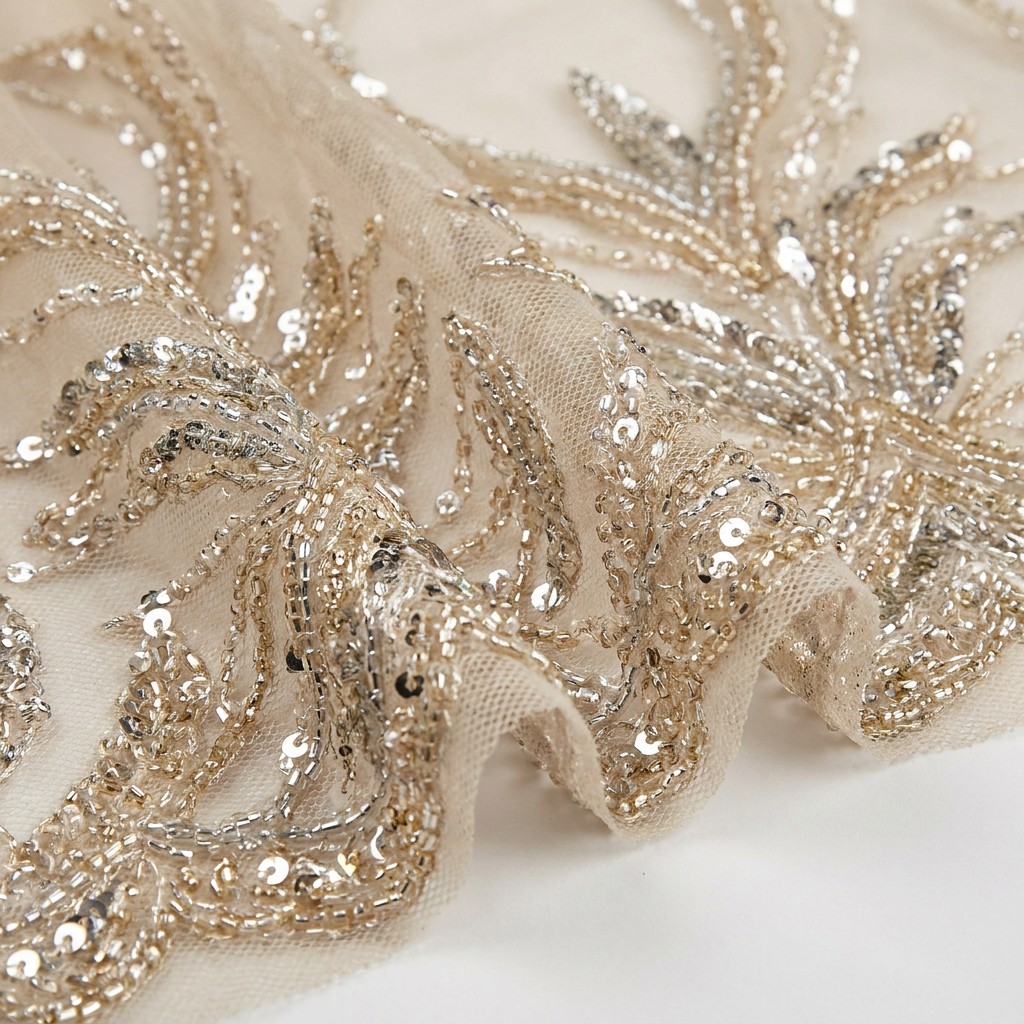
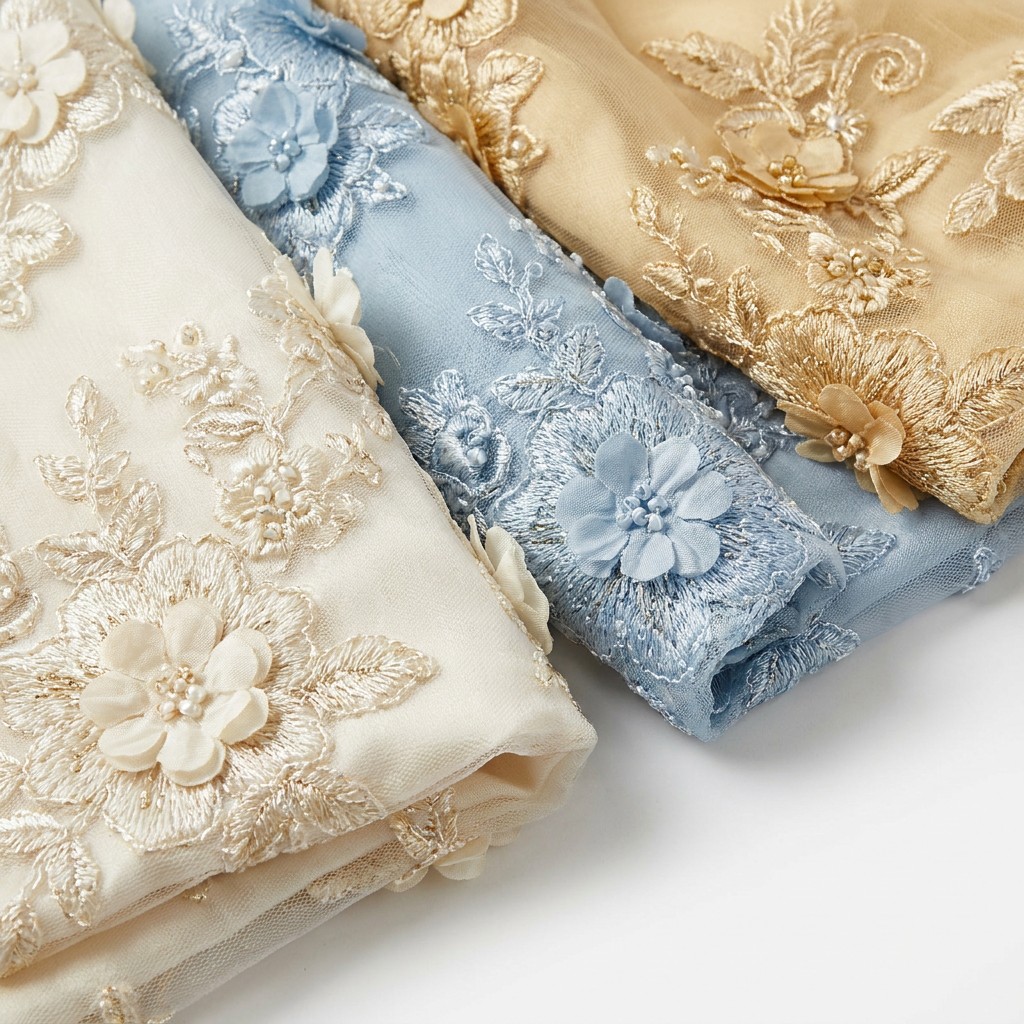
Beaded lace trim is a specialized narrow decorative border engineered to embellish hemlines, sleeve cuffs, corsets, and bridal veils. Modern computerized embroidery machines and experienced hand-beading artisans combine tubular bugle beads, faceted seed beads, and iridescent sequins onto sheer netting foundations. In commercial B2B garment engineering, border drape, bead security, and trim durability depend directly on three foundational pillars:
1. Base Foundation Mesh and Edge Construction
The underlying substrate establishes the mechanical load-bearing capacity and edge crispness of the lace border:
- 100% Polyamide Illusion Netting: The industry standard for bridal gown hemlines and illusion necklines (30–50 GSM). Consequently, this fine mesh foundation delivers exceptional transparency, soft skin touch, and clean laser-cut or hand-trimmed scalloped edges.
- Organza-Reinforced Scalloped Borders: Formulated with crisp polyester organza underlays (45–65 GSM). Specifically, this backing provides enhanced dimensional stability for heavy crystal beading on structured bridal bodices.
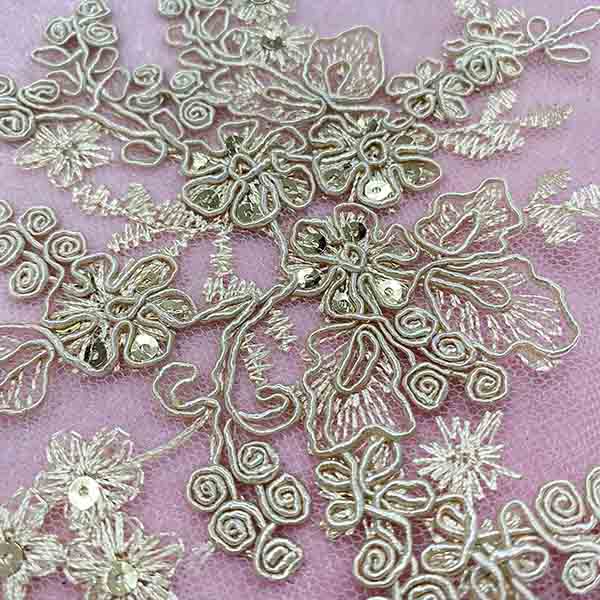
- Water-Soluble Chemical Guipure Foundations: Freestanding beaded lace trims where the base fabric is completely dissolved, leaving dense, structural corded embroidery and beadwork.
2. Glass Bead Materials and Anchoring Chemistry
Selecting certified bead polymers and high-refraction glass directly prevents chipping, discoloration, and thread shearing:
- Faceted K9 Crystal and Czech Seed Beads: Mandatory for luxury couture. Moreover, optical glass beads endure steam pressing temperatures up to 140°C (284°F), maintain brilliant prismatic reflection, and resist chemical dry-cleaning agents.
- High-Tenacity Nylon Monofilament and Core-Spun Threads: In addition, all structural bead lines are secured using abrasion-resistant bonded nylon threads (size 69 or 92) with double back-tack lock knots every 2 inches to prevent continuous unraveling if a thread is cut.
3. Scallop Repeat Precision and Edge Symmetry
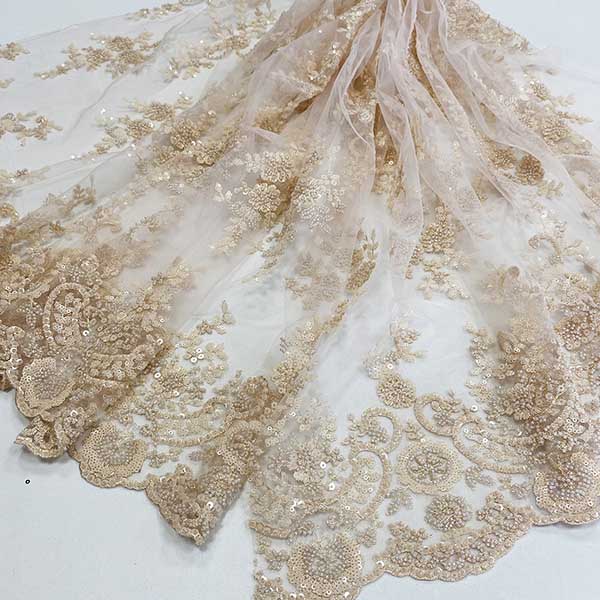
To ensure seamless pattern alignment across garment hemlines, computerized embroidery machinery maintains strict repeat spacing (e.g., 5 cm, 8 cm, or 12 cm scallop repeats) with less than ±1.5% linear deviation per 50-yard roll.
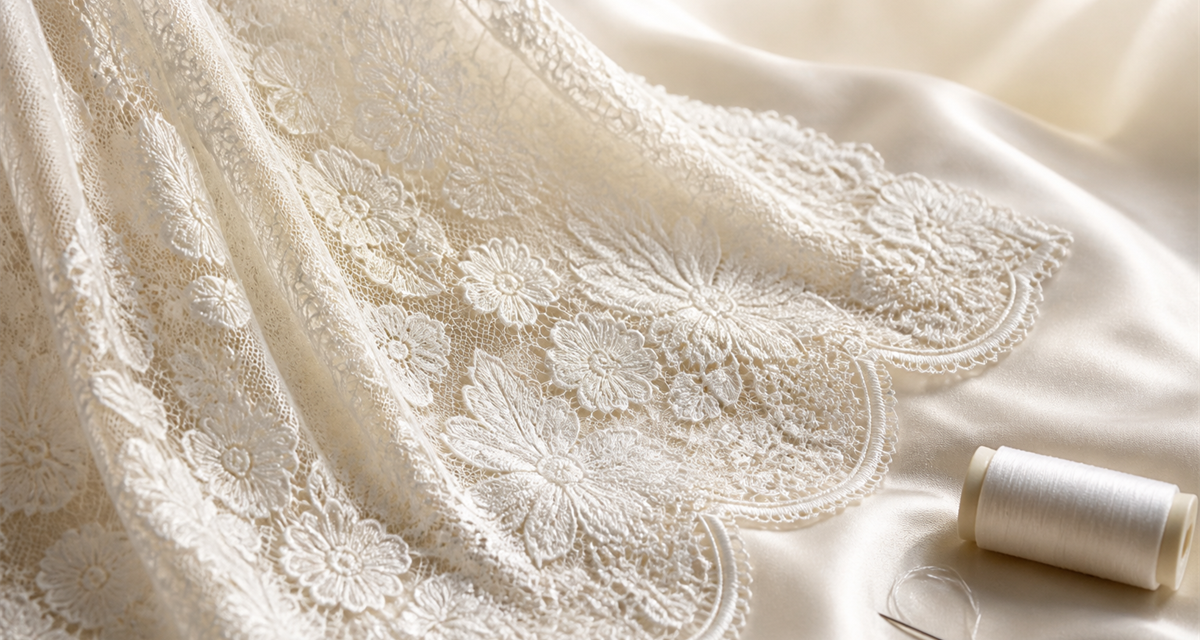
Key Takeaways for B2B Beaded Lace Trim Procurement
- Specify Exact Trim Width and Scallop Repeat: Clearly define total border width (e.g., 3 cm, 6 cm, 10 cm, or 15 cm) and usable sewing margin along the top edge to facilitate clean garment assembly.
- Require Double Lock-Stitch Bead Anchoring: Insist on segmented knotting intervals so that cutting along seam allowances does not trigger sequential bead loss.
- Verify Steam and Dry-Cleaning Stability: Ensure all glass beads, pearls, and metallic cordings withstand commercial dry cleaning without melting or shedding surface coatings.
- Leverage Direct Factory MOQs: Partner with integrated mills offering a flexible 200-yard minimum order quantity per custom design, accompanied by physical strike-off samples within 5–7 working days.
5-Step Beaded Lace Trim Wholesale Procurement Workflow
- Step 1: Technical Specification Submission
In the initial stage, buyers submit CAD artwork or reference swatches indicating trim width, bead types (seed beads, bugle beads, faux pearls), base mesh composition, and target Pantone color codes. - Step 2: Strike-Off Sampling & Bead Density Calibration
Next, our engineering team digitizes the border pattern and produces a 1-yard strike-off on actual machinery. Quality auditors inspect this swatch under standard D65 light booths to verify bead luster, edge symmetry, and hand feel. - Step 3: Base Mesh Tension & Knot Tenacity Testing
Before mass production begins, technicians calibrate frame tension to prevent puckering. In addition, tensile testing ensures bead anchoring threads withstand over 10.0 N of direct pulling force. - Step 4: Inline 100% Visual and Manual Defect Inspection
During the embroidery run, experienced craftspeople inspect every yard for missing beads, cracked glass, loose knots, and skipped stitches across the entire continuous trim roll. - Step 5: Roll Finishing and Protective Spool Packaging
Finally, workers wind finished beaded lace trims onto reinforced cardboard spools with protective tissue interleaving, ensuring heavy beadwork does not crush delicate mesh edges during maritime transit.
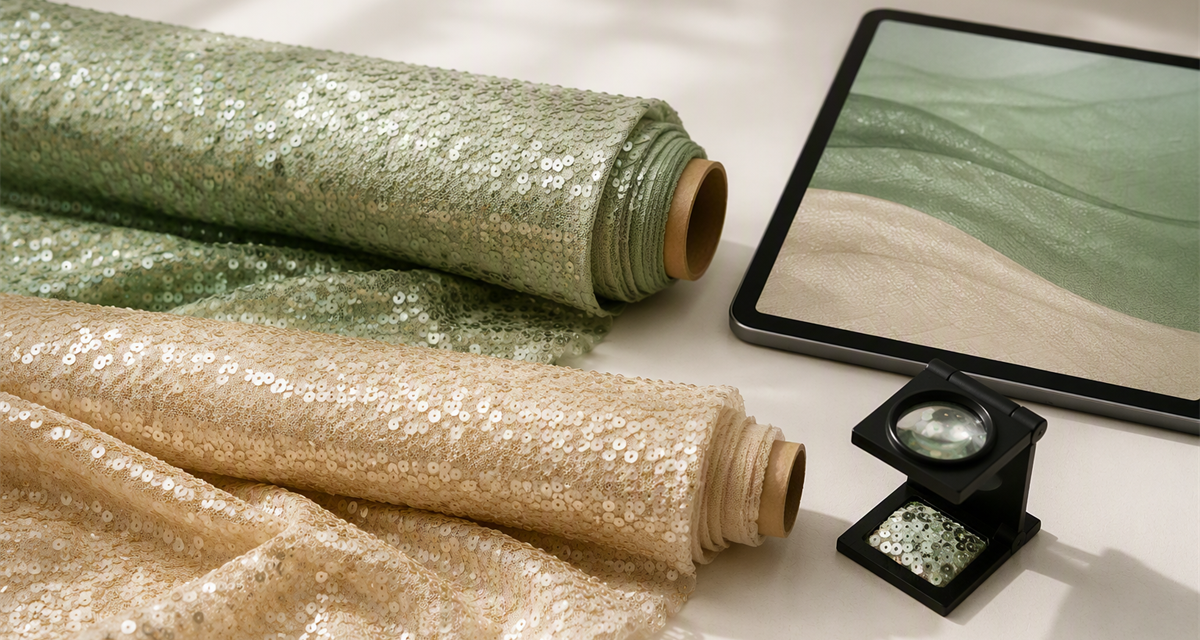
Technical Specifications & Material Tolerance Matrix
| Technical Parameter | Illusion Tulle Beaded Trim | Organza Corded Beaded Trim | Heavy Guipure Beaded Trim |
|---|---|---|---|
| Base Mesh Composition | 100% Polyamide Mesh | 100% Polyester Organza | 100% Polyester Chemical Lace |
| Bead Components | Czech Glass Seed Beads & Pearls | Bugle Beads & Metallic Cord | Heavy Glass Crystals & Beads |
| Trim Widths Available | 2 cm, 4 cm, 7 cm, 10 cm | 5 cm, 8 cm, 12 cm, 18 cm | 6 cm, 10 cm, 15 cm, 22 cm |
| Scallop Repeat Deviation | < ±1.0% per 50 yards | < ±1.2% per 50 yards | < ±1.5% per 50 yards |
| Thermal Tolerance | Up to 140°C (284°F) | Up to 150°C (302°F) | Up to 150°C (302°F) |
| Recommended Applications | Veil borders, sleeve cuffs | Bridal hemlines, corsets | Couture evening gowns, capes |
| Factory MOQ | 200 Yards / Custom Design | 200 Yards / Custom Design | 200 Yards / Custom Design |
Quality Control in Beaded Lace Trim Wholesale Production
To guarantee that exported trim spools meet rigorous couture standards, our factory quality control team executes thorough physical evaluations:
| Inspection Dimension | Testing / Evaluation Method | Tolerance & Acceptance Criteria | Actionable Failure Trigger |
|---|---|---|---|
| Bead Retention Strength | ASTM D3939 / Tape Pull & Snag Test | Zero bead loss on 3M adhesive lift test | > 1 detached bead per linear yard |
| Colorfastness to Washing | AATCC 61 (2A Test) / ISO 105-C06 | Grade 4.0 or higher (AATCC Gray Scale) | Visible color staining on adjacent white mesh |
| Colorfastness to Crocking | AATCC 8 / ISO 105-X12 (Crockmeter) | Dry Rubbing: Grade 4.5 / Wet Rubbing: Grade 4.0 | Pearl luster coating flaking under friction |
| Border Scallop Consistency | Digital Caliper & Optical Gauge | Scallop height variation < ±1.0 mm | Uneven wave depth exceeding ±2.0 mm |
| Sewing Margin Usability | Steel Ruler Width Scan | Minimum 8 mm unembellished sewing margin | Beads stitched into machine presser foot area |
| Needle Fragment Detection | Conveyor Metal Detector | 100% Metal Detection Pass (0.8mm Fe probe) | Any ferrous needle tip detected in trim spool |
For additional details regarding our embroidery processes, explore our B2B textile manufacturing standards, discover our embroidery fabric collections, or view our premium custom decorative fabrics engineered for global fashion brands.
Frequently Asked Questions (FAQ)
What is the minimum order quantity (MOQ) for custom beaded lace trim wholesale?
Our unified factory minimum order quantity is strictly 200 yards per custom border pattern, bead configuration, or Pantone colorway. Furthermore, we support multi-width split orders across the same embroidery pattern to accommodate different garment trim placements.
Can you match beaded lace trims to specific bridal gown fabric swatches?
Yes. Our R&D team in Ruzhou, Henan specializes in custom color matching against physical lace, silk organza, or crepe swatches. In addition, physical strike-offs are typically delivered within 5–7 working days.
How does Yunfan Textile prevent beads from breaking during machine sewing?
We engineer a dedicated 8mm to 12mm unembellished mesh sewing allowance along the upper edge of every trim. Consequently, garment factory operators can feed trims through high-speed sewing machines without contacting glass beads or causing needle breakage.
What testing standards govern exported beaded lace trim spools?
All production trim spools undergo standardized testing, including ASTM D5430 for visual defect grading, AATCC 61/8 for colorfastness, and ASTM D3939 for dynamic bead retention.
Conclusion
In summary, securing a reliable supply of beaded lace trim wholesale products requires partnering with an experienced manufacturing mill that masters precision scallop digitizing, double lock-stitch bead knotting, and defect-free spool winding. By defining clear technical criteria for trim width, glass bead refraction, and needle safety margins, fashion brands reduce assembly defects and deliver exquisite couture details. Yunfan Textile provides end-to-end B2B trim development, strict 4-point system quality inspections, and reliable global logistics support.
Direct B2B Sourcing on Alibaba
Explore our full catalogue of custom sequin and embroidered lace trims, order verified production samples, and trade with Trade Assurance on our official Alibaba store.
Request Fabric Samples & Custom Sourcing Consultation
Request lace trim samples and share your target width, bead type, scallop repeat, and colour reference.
Talk to Morris directly:
- 📧 Email: morris@yunfantextile.com
- 💬 WhatsApp 1: +86 156 3752 5803
- 💬 WhatsApp 2: +86 175 1619 6727